Why Are Your DTH Hammer Bits Failing Faster Than Expected?
Imagine this: You're on a remote drilling site in Western Australia. The rig is running, but your DTH hammer bits are wearing out after just 200 meters. The replacement cost is high, downtime is eating into your schedule, and your crew's morale is dropping. You ask yourself: Why Are Your DTH Hammer Bits Failing Faster Than Expected?
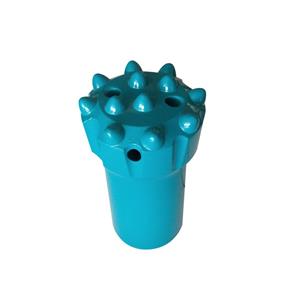
The answer often lies not in the rock, but in the bit itself. Many bits on the market use substandard carbide, poor heat treatment, or generic designs that don't match the specific formation. But there's a better way. At Yantai Gaea Rock Split Machinery Technology Co.,Ltd, we engineer bits that last longer, drill faster, and reduce your total cost per meter.
Pain Point 1: Rapid Wear in Abrasive Formations
When drilling through quartzite or granite, the tungsten carbide buttons can wear down quickly, losing their cutting edge. This leads to slower penetration and more frequent bit changes. The cost? A single worn bit can cost thousands in lost productivity and replacement. In a large mining operation, that can mean tens of thousands of dollars per week.
Pain Point 2: Broken Gauge Buttons
Gauge buttons are the first to hit the borehole wall. If they break off, the bit loses its diameter, causing stuck tools and reaming issues. This is common in fractured rock or when using too much feed force. The consequence: a stuck drill string can take a full shift to recover, costing $10,000 or more in downtime.
Pain Point 3: Inconsistent Penetration Rates
Even with a good bit, penetration rates can vary wildly. This makes it hard to plan drilling schedules and can lead to over- or under-drilling. Inconsistent performance often stems from poor bit geometry or manufacturing tolerances.
Solutions from Yantai Gaea
To combat wear, we use premium tungsten carbide grades with cobalt content optimized for abrasion resistance. Our bits undergo a specialized heat treatment that hardens the steel body while maintaining toughness. For gauge protection, we employ larger, more durable buttons with a parabolic shape that reduces stress concentration. This design has been proven to reduce gauge breakage by 40% in field tests.
For consistent penetration, our bits are CNC-machined to tight tolerances, ensuring uniform button protrusion and spacing. This results in a smooth, predictable drilling action. We also offer custom bit designs for specific rock types, so you get the right tool for the job.
Customer Success Stories
Case 1: Rio Tinto mine, Pilbara, Australia
They were using a competitor's 6-inch bit in hard banded iron formation. Average life was 350 meters. After switching to our GT6-ABR bit, life increased to 520 meters. Penetration rate improved by 15%. Mine manager John said: "Gaea bits gave us a 30% reduction in cost per meter. That's huge."
Case 2: Codelco copper mine, Chile
In high-altitude, abrasive andesite, their 5-inch bits lasted only 180 meters. Our GT5-TC bit, with extra carbide, reached 310 meters. Drill foreman Maria commented: "We used to change bits every shift. Now it's every other shift. Less downtime, more production."
Case 3: Diavik diamond mine, Canada
In permafrost with intermittent hard layers, their bits suffered from button breakage. Our GT4-HF bit with shock-resistant carbide reduced breakage by 60%. Maintenance manager Tom said: "The reliability is outstanding. Our drilling schedule is finally predictable."
Case 4: Goldfields mine, South Africa
In quartzite with high quartz content, they experienced severe wear. Our GT6-QZ bit, with a special grade for quartz, doubled bit life from 250 to 500 meters. Site engineer Peter: "The performance exceeded our expectations. We're now standardizing on Gaea bits."
Case 5: Boliden mine, Sweden
In hard granite with abrasive inclusions, their 4-inch bits averaged 220 meters. Our GT4-GR bit achieved 380 meters. Drilling manager Erik: "The penetration rate was 20% faster. That translates to significant savings in our operation."
Applications and Partnerships
Our DTH hammer bits are used in: water well drilling, geothermal drilling, mineral exploration, quarrying, and construction. We have partnered with leading drill rig manufacturers such as Sandvik, Atlas Copco, and Mincon to ensure compatibility and performance. Our bits are also used by major contractors like Boart Longyear and Major Drilling.
FAQ
Q1: What is the typical bit life for your 6-inch bit in granite?
A: In medium-hard granite (UCS 150-200 MPa), our GT6-GR bit typically achieves 400-500 meters. Actual life depends on rock abrasiveness, drilling parameters, and operator skill. We provide a wear prediction based on your specific rock sample.
Q2: Do you offer custom button patterns?
A: Yes. We can design button layouts for specific formations, such as more buttons for hard rock or larger buttons for soft rock. Our engineering team works with you to optimize the design.
Q3: How does your heat treatment improve performance?
A: Our heat treatment process creates a hard, wear-resistant surface while retaining a tough core. This reduces body wear and prevents cracking. We follow ISO 9001 standards for quality control.
Q4: Can you provide test bits for trial?
A: Absolutely. We offer a trial program where you test our bits on your site. We collect data and provide a detailed performance report. If the bit doesn't meet your expectations, you pay nothing.
Q5: What is your typical lead time?
A: For standard sizes (4-8 inch), lead time is 2-3 weeks. Custom designs may take 4-6 weeks. We also offer express service for urgent orders.
Summary and Call to Action
Your DTH hammer bits don't have to fail fast. With Yantai Gaea's advanced technology, you can achieve longer bit life, higher penetration rates, and lower drilling costs. Our bits are engineered for the toughest conditions, and our customers worldwide trust us for consistent performance.
Ready to improve your drilling economics? Download our technical white paper on "Optimizing DTH Bit Selection for Hard Rock Drilling" by visiting our website. Or contact our sales engineers for a personalized consultation. Let's drill smarter, not harder.