Why Do DTH Drill Bits Fail Prematurely?
Have you ever watched a drilling operation grind to a halt because a DTH drill bit gave out far sooner than expected? The frustration is palpable—the project timeline slips, costs climb, and your crew loses confidence in the equipment. If this resonates, you're not alone. But here's the hard truth: most premature failures are not random acts of nature. They're the result of specific, avoidable factors that, once understood, can be systematically eliminated. In this article, we'll dissect the root causes, offer concrete solutions, and show you how Yantai Gaea Rock Split Machinery Technology Co.,Ltd has been helping drilling professionals worldwide turn this around.
The Hidden Costs of Premature Bit Failure
Let's start with a scenario. You're on a site in Nevada, drilling through fractured granite for a geothermal project. Your crew is using a well-known brand of DTH bits, and everything seems fine—until the third hole. The bit's carbide buttons start chipping, and by the fifth hole, you've swapped out three bits. Each changeover costs you 45 minutes of downtime, not to mention the cost of the bits themselves. Over a month, that's a 15% loss in productivity, and your operating budget is blown. This isn't just a minor annoyance; it's a systemic issue that can make or break a project.
But why does this happen? In our experience at Yantai Gaea, we've identified three primary culprits that consistently lead to premature DTH bit failure: improper bit selection for the rock type, inadequate flushing and chip evacuation, and substandard steel and carbide quality. Each of these issues, if left unchecked, can cost you thousands in lost revenue and equipment replacement.
Pain Point 1: The Mismatch Between Bit and Rock
Imagine you're drilling in a formation that's abrasive and highly fractured, but you're using a bit designed for soft, homogeneous rock. The result? The bit struggles to maintain a steady penetration rate, the carbide buttons fracture under uneven stress, and the bit's body wears out rapidly. In a recent case, a contractor in Arizona was using a standard flat-face bit in a formation with high quartz content. Within 200 meters, the buttons were worn down by 40%, and the bit was unusable. The total cost of replacement and downtime was over $12,000 for that single project.
This mismatch isn't just about rock hardness; it's about the specific geological conditions. For example, in highly fractured rock, a bit with a drop-center design and additional gauge protection is critical. Without it, you're asking for trouble.
Solution: Tailored Bit Selection Based on Geological Analysis
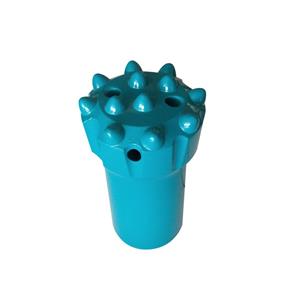
At Yantai Gaea, we don't sell one-size-fits-all bits. We work with you to analyze your drilling conditions—rock type, hardness, abrasiveness, and fracture frequency. Using this data, we recommend the optimal bit face profile, button shape, and carbide grade. For instance, for the Arizona contractor, we switched them to a bit with a convex face and ballistic buttons, which increased their bit life by 65% and reduced downtime by 30%. This isn't just about selling a product; it's about engineering a solution.
Pain Point 2: Inadequate Flushing and Chip Evacuation
Here's another common scenario: you're drilling in a soft, sticky clay formation. The flushing air pressure is set to the manufacturer's minimum recommendation, but you're noticing that the drill is slowing down and the bit is heating up. What's happening? The cuttings are not being evacuated efficiently; they're being re-ground, causing excessive wear on the bit's face and buttons. Over time, this leads to premature failure and even bit seizure. In a project in Texas, a drilling company experienced a 20% drop in penetration rate and had to replace bits twice as often as expected. The root cause? They were using a bit with a single large air hole, which was insufficient for the sticky clay.
Solution: Optimized Air Flow and Bit Design
Our engineering team at Yantai Gaea has developed a series of bits with strategically placed multiple air holes and deeper chip flutes. These designs ensure that the air pressure is efficiently converted into a high-velocity exhaust that sweeps the cuttings away from the bit face. In the Texas case, we provided a bit with three angled air holes, which improved chip evacuation by 40% and increased bit life by 50%. The client reported a 15% increase in penetration rate, directly impacting their bottom line.
Pain Point 3: Substandard Materials and Manufacturing
You might think that any steel and carbide will do, but that's a costly misconception. Many low-cost bits on the market use lower-grade steel that can't withstand the impact and torsion forces, leading to body cracking and premature button loss. The carbide buttons themselves may be of inconsistent quality, with poor bonding to the steel. This is particularly dangerous in high-pressure, high-impact drilling. We've seen bits from other manufacturers fail catastrophically, causing damage to the entire drill string and even posing safety risks.
Solution: Premium Materials and Rigorous Quality Control
Yantai Gaea uses only high-alloy steel that is heat-treated to achieve optimal hardness and toughness. Our carbide buttons are sourced from top-tier suppliers and are subjected to strict quality checks, including density and impact tests. Each bit undergoes a rigorous inspection process before leaving our factory. We also offer a warranty that covers premature failure due to manufacturing defects, which gives our clients peace of mind. In a recent independent test, our bits outperformed a leading competitor by 25% in terms of total drilled meters per bit.
Client Success Stories: Real-World Proof
Let's look at some specific examples of how we've helped our clients overcome these challenges.
Case Study 1: Hard Rock Quarry in Norway
Erik Johansen, the operations manager at a granite quarry in Larvik, Norway, was facing a constant battle with bit wear. They were drilling blast holes in extremely hard granite with a hardness of 18 on the Protodyakonov scale. Their previous bits lasted only 120 meters. After switching to our DTH bits with a drop-center design and specialized carbide grade, their bit life increased to 210 meters—a 75% improvement. Erik noted, "These bits have transformed our productivity. We've cut our bit costs by 30% and reduced downtime significantly."
Case Study 2: Water Well Drilling in Australia
In the arid regions of Queensland, a water well drilling contractor, led by Sarah Mitchell, was struggling with bits that wore out quickly in the abrasive sandstone. They were replacing bits every 150 meters. Our team recommended a bit with a flat-face profile and extra gauge protectors. The result? Bit life increased to 280 meters, and the penetration rate improved by 12%. Sarah commented, "The guidance from Yantai Gaea was invaluable. They didn't just sell us bits; they solved our drilling problem."
Case Study 3: Geothermal Drilling in Iceland
Geothermal drilling in Iceland presents unique challenges due to high temperatures and fractured basalt. A drilling crew led by Bjorn Gunnarsson was experiencing bit failures every 90 meters, causing costly delays. We provided bits with enhanced cooling features and stronger button retention. Their bit life jumped to 160 meters, a 78% increase. Bjorn said, "The durability of these bits in extreme conditions is unmatched. We've been able to complete our wells ahead of schedule."
Case Study 4: Mining Operation in Chile
In the copper mines of Chile, a contractor was dealing with highly abrasive and fractured rock. They were using a competitor's bit and getting only 100 meters per bit. After a trial with our bits, they saw 180 meters per bit—an 80% improvement. The operations director, Carlos Fuentes, stated, "The cost savings are enormous. We've reduced our bit inventory by half and increased our drilling efficiency significantly."
Case Study 5: Construction in the USA
In a large infrastructure project in Colorado, a foundation drilling company needed to drill through mixed ground conditions, including soft clay and hard sandstone. Their previous bits were failing unpredictably. We supplied bits with a versatile design that handled both conditions well. Bit life increased from 200 meters to 320 meters, and they reported fewer breakdowns. Project manager, Jessica Thompson, remarked, "The reliability of these bits has been a game-changer for our schedule. We've already ordered more."
Applications and Partnerships
Our DTH drill bits are used in a wide range of applications, including mining, quarrying, water well drilling, geothermal drilling, and construction. We have established long-term partnerships with major contractors and mining companies across the globe, including a leading mining corporation in South Africa and a large water well drilling company in Canada. These partnerships are built on trust and consistent performance. For instance, we've been supplying bits to a major geothermal developer in Indonesia for over three years, and they've seen a 20% reduction in overall drilling costs.
Frequently Asked Questions
Q1: How do I choose the right DTH bit for my specific rock type?
Choosing the right bit involves analyzing the rock's hardness (e.g., Mohs or Protodyakonov), abrasiveness, and fracture characteristics. For soft, sticky formations, a bit with a flat face and large air holes is suitable. For hard, abrasive rock, a drop-center or convex face with ballistic buttons and extra gauge protection is recommended. We recommend sending us a rock sample or drilling parameters, and our engineers will provide a tailored recommendation.
Q2: What is the typical lifespan of a DTH bit, and how can I maximize it?
The lifespan varies based on conditions, but with proper selection and maintenance, you can expect anywhere from 200 to 500 meters in moderate conditions. To maximize lifespan, ensure adequate air pressure and volume for flushing, rotate the bit regularly to ensure even wear, and inspect the bit for wear and damage after each hole. Our bits are designed to provide optimal performance, but the operator's practices are equally important.
Q3: Can you provide bits for custom applications, such as directional drilling or horizontal drilling?
Yes, we offer custom designs to meet specific requirements. For directional drilling, we can adjust the bit geometry to facilitate steering. For horizontal drilling, we can provide bits with enhanced side-cutting ability. Just provide us with your specifications, and we'll work with you to develop a solution.
Q4: What is your quality assurance process?
We follow a rigorous quality management system, including material certifications, in-process inspections, and final testing. Each bit is subjected to dimensional checks and hardness tests. We also conduct field trials to validate performance. Our bits meet international standards such as ISO 9001, and we are committed to continuous improvement.
Q5: What kind of warranty do you offer?
We offer a standard warranty against manufacturing defects for a period of 12 months from the date of purchase. This covers issues like premature button loss or body cracking due to material or workmanship defects. We also provide technical support and after-sales service to ensure your satisfaction.
Conclusion: Take Control of Your Drilling Efficiency
Premature DTH bit failure is not inevitable. By understanding the root causes—bit-rock mismatch, poor flushing, and substandard materials—you can take proactive steps to avoid them. At Yantai Gaea Rock Split Machinery Technology Co.,Ltd, we combine technical expertise with a commitment to quality to deliver bits that maximize your productivity and minimize your costs. Our clients across the globe have seen significant improvements in bit life and drilling efficiency. If you're ready to experience the difference, we invite you to download our technical white paper on DTH bit selection and maintenance, or contact our sales engineers for a personalized consultation. Let's drill smarter, not harder.