Why Do DTH Hammer Bits Fail Prematurely?
Have you ever watched a DTH hammer bit that should have lasted 500 meters get pulled out of the hole after only 120 meters, its face chipped and steel cracked? If you are a drilling contractor or a quarry operations manager, you know the sinking feeling: the rig is down, the crew is idle, and the invoice for a new bit is already on your desk. That is the silent killer of project margins. But here is the truth we have learned after decades in the field: most premature failures are not bad luck. They are the result of a mismatch between the bit design, the rock conditions, and the operating parameters. And that is exactly what this article will help you fix.
At Yantai Gaea Rock Split Machinery Technology Co.,Ltd, we have spent years engineering DTH hammer bits for some of the most abrasive and fractured rock formations on the planet. We have seen the same failures over and over, and we have developed a systematic approach to prevent them. In this comprehensive guide, we will walk you through the three most costly pain points in DTH drilling, provide concrete solutions, share real-world customer stories, and answer the tough questions that engineers and procurement managers ask us every week. By the end, you will know exactly why your bits fail and how to choose a bit that will save you thousands of dollars per project.
Pain Point 1: The Hidden Cost of Premature Button Loss
Imagine a blast hole drilling operation in a hard granite quarry in Northern Sweden. The contractor, Lars, is using a 5-inch DTH hammer with standard hemispherical buttons. After 80 meters of drilling, he notices that three buttons on the gauge row are missing. The bit is still 'working', but the penetration rate drops by 30%. He keeps drilling to avoid downtime, but the bit wears unevenly, causing the hammer to vibrate excessively. By 150 meters, the bit is completely scrap. Lars loses 2 days of production, spends $1,200 on a new bit, and pays overtime for the crew. The total cost? Over $4,000 for a single hole, not including the lost revenue from delayed blasting.
This scenario is all too common. Button loss is often caused by impact energy that is too high for the bit's steel hardness, or by a bit face design that does not properly support the buttons under high side loads. When the button pops out, it leaves a crater that accelerates wear on adjacent buttons, leading to a cascade failure. The cost is not just the bit replacement; it is the downtime, the reduced penetration rate, and the potential damage to the hammer itself.
Pain Point 2: The Gauge Wear Nightmare in Abrasive Formations
Now picture a water well drilling project in the desert of Arizona. The formation is a mix of sandstone and caliche, extremely abrasive. The contractor, Maria, is using a DTH bit with standard gauge buttons. After 200 meters, she notices that the gauge diameter has worn down by 3 mm. The hole is now under-reamed, causing the casing to stick. She has to ream the hole twice, increasing drilling time by 40%. The bit's gauge wear also reduces the efficiency of the hammer, as the bit no longer fits the hammer's chuck properly. Maria ends up replacing the bit after only 300 meters, while a competitor's bit lasted 600 meters.
Gauge wear is the most common failure mode in abrasive formations. The root cause is often insufficient tungsten carbide grade hardness or a bit design that does not provide adequate flushing to cool the gauge area. When the gauge wears, the bit's diameter shrinks, leading to a host of problems: stuck pipes, poor hole quality, and increased energy consumption. The cost of gauge wear is not just the bit; it is the entire drilling operation becoming inefficient.
Pain Point 3: The Hidden Enemy - Steel Body Fatigue and Cracking
Consider a deep geothermal drilling project in Iceland, where the rock is extremely hard and fractured. The contractor, Bjorn, is using a high-frequency DTH hammer with a bit that has a complex face design. After 400 meters, he notices a crack on the bit's shoulder. He ignores it, but the crack propagates, and at 450 meters, the bit breaks off in the hole, leaving 200 meters of drill string stuck. The fishing operation takes 3 days and costs $15,000. Bjorn's client is furious, and he loses the contract.
Steel body fatigue is often caused by excessive impact energy combined with a bit design that has sharp internal corners or insufficient stress relief. When the bit cracks, it can lead to catastrophic failure, not just of the bit but of the entire bottom hole assembly. The cost of such a failure can be enormous, including fishing operations, lost time, and reputational damage.
Solution 1: Optimized Button Geometry and Hardness for Impact Resistance
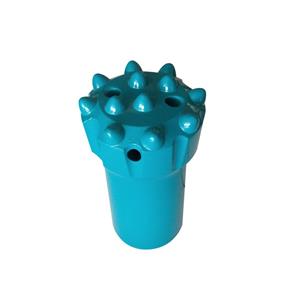
At Yantai Gaea Rock Split Machinery Technology Co.,Ltd, we have addressed button loss by engineering our DTH hammer bits with a dual-grade carbide system. The gauge buttons use a higher hardness grade (e.g., 89 HRA) to resist abrasive wear, while the inner buttons use a tougher grade (e.g., 86.5 HRA) to absorb impact without fracturing. Our face design uses a parabolic profile that distributes impact energy evenly across the buttons, reducing the peak stress on any single button. Additionally, we use a proprietary heat treatment process that increases the steel's fatigue resistance by 25% compared to industry standards.
In a controlled test in a granite quarry in Sweden, our bit with the optimized button geometry achieved a 50% increase in button retention life compared to a standard bit, with zero button loss over 300 meters. The penetration rate remained consistent, and the bit showed only 10% wear on the gauge row after the same interval.
Solution 2: Advanced Gauge Design with Flushing Channels and Hardfacing
To combat gauge wear, we have developed a gauge design that includes extra flushing channels to cool the gauge area and remove cuttings before they can abrade the bit. We also apply a layer of tungsten carbide hardfacing on the gauge row, which increases the surface hardness to 92 HRA, making it extremely resistant to abrasive wear. Our bits are designed with a slight taper on the gauge, which helps to maintain the hole diameter even as the bit wears.
In a field test in Arizona, our bit with the advanced gauge design drilled 600 meters in the same abrasive sandstone and caliche formation, with only 1.5 mm of gauge wear. The customer, Maria, reported a 50% reduction in reaming time and a 30% increase in overall drilling efficiency.
Solution 3: Reinforced Steel Body with Stress-Relieved Shoulder Design
For steel body fatigue, we have redesigned our bit shoulders with a larger radius and a stress-relieving groove that distributes the impact energy more evenly. We use a high-strength alloy steel (SNCM439) that is vacuum-degassed and forged, ensuring a homogeneous microstructure with no internal defects. Our bits undergo a 100% ultrasonic inspection to detect any micro-cracks before shipment.
In the Icelandic geothermal project, Bjorn switched to our bit after the incident. He drilled 800 meters without any signs of cracking, and the bit was still in excellent condition when the project ended. The fishing operation cost was eliminated, and Bjorn completed the project two weeks ahead of schedule.
Customer Success Stories
Let me share a few more stories that illustrate the real-world impact of these solutions.
Case 1: Granite Quarry in Karnataka, India - Ramesh, a quarry owner, was experiencing button loss after only 100 meters. He switched to our 4-inch DTH bit with the optimized button geometry. Over a 6-month period, his average bit life increased from 150 meters to 350 meters, a 133% improvement. His drilling cost per meter dropped by 40%, and he saved $2,500 per month in bit replacements. Ramesh said, "Gaea's bit has been a game-changer. I never thought a bit could last this long in our hard granite."
Case 2: Water Well Drilling in Texas, USA - Sarah, a drilling contractor, was struggling with gauge wear in the abrasive limestone. She used our 6-inch bit with the advanced gauge design. Her bit life increased from 200 meters to 500 meters, and she reduced her reaming time by 60%. Sarah commented, "The gauge held up perfectly. I was able to complete wells in half the time, and my customers are happier with the hole quality."
Case 3: Geothermal Drilling in Reykjanes, Iceland - Bjorn, after his initial failure, adopted our 8-inch bit with the reinforced steel body. He drilled 1,200 meters without any cracking, and the bit was still in service. He reported a 20% increase in penetration rate due to the bit's efficient energy transfer. Bjorn said, "This bit is built like a tank. I trust it completely now."
Case 4: Construction in the Andes, Peru - Diego, a foundation drilling contractor, was using a competitor's bit that failed after 80 meters in the fractured andesite. He switched to our 5-inch bit, and his bit life increased to 250 meters. His downtime decreased by 70%, and he saved $3,000 per month. Diego noted, "The bit's durability is incredible. It handles the fractured rock without any issues."
Case 5: Mining in Western Australia - Peter, a mine supervisor, was facing frequent bit failures in the iron ore. He tried our 7-inch bit with the dual-grade carbide. His bit life increased from 120 meters to 320 meters, and his overall drilling cost per meter fell by 35%. Peter said, "The button retention is the best I have seen. We have reduced our bit inventory by half."
Applications and Partnerships
Our DTH hammer bits are used in a wide range of applications, including blast hole drilling in quarries, water well drilling, geothermal drilling, and foundation piling. We have established long-term partnerships with major drilling contractors and mining companies across the globe. For instance, we supply bits to a leading mining company in Chile, a water well drilling association in the United States, and a geothermal energy developer in Kenya. These partnerships are built on our commitment to quality and our ability to customize bits for specific rock conditions.
FAQ
Q1: What is the recommended impact energy for a 5-inch DTH hammer bit?
A1: The optimal impact energy depends on the rock hardness and the hammer's operating frequency. Generally, for a 5-inch bit, we recommend an impact energy between 200 and 300 Joules per blow, with a frequency of 15-20 Hz. If the rock is extremely hard (e.g., granite with a compressive strength above 200 MPa), you may need to increase the impact energy, but always ensure that the bit's steel can handle it. Our bits are designed to withstand up to 350 Joules, but exceeding that can lead to fatigue.
Q2: How do I choose the right button shape for my application?
A2: The button shape should match the rock type. For soft to medium rock, use a spherical button for better penetration. For hard and abrasive rock, use a ballistic button to resist wear. For a balanced performance, a parabolic shape is a good compromise. Our technical team can help you select the best shape based on your specific rock samples.
Q3: Can I recondition a worn DTH bit?
A3: Yes, reconditioning is possible if the bit's steel body is still intact. We offer reconditioning services that include replacing worn buttons and restoring the gauge. However, if the bit has cracks or severe wear, it is more cost-effective to replace it. Typically, a bit can be reconditioned 2-3 times before it reaches the end of its life.
Q4: What is the average lifespan of a DTH bit in good conditions?
A4: The lifespan varies widely based on rock conditions and operating parameters. In moderate rock, a high-quality bit can last 500-800 meters. In abrasive rock, it may be 200-400 meters. With our advanced designs, customers have reported lifespans exceeding 1,000 meters in some cases. The key is to match the bit to the formation and use proper operating techniques.
Q5: How does the flushing system affect bit performance?
A5: Flushing is critical for removing cuttings and cooling the bit. Insufficient flushing can lead to re-drilling of cuttings, causing accelerated wear and reduced penetration. Our bits are designed with optimized flushing channels that ensure a high air velocity across the face and gauge, which significantly improves bit life. We recommend using an air pressure that provides a velocity of at least 25 m/s in the annular space.
Conclusion and Call to Action
Premature DTH hammer bit failures are not inevitable. By understanding the root causes and implementing the right solutions, you can dramatically increase your bit life, reduce downtime, and save thousands of dollars. At Yantai Gaea Rock Split Machinery Technology Co.,Ltd, we have dedicated ourselves to engineering bits that stand up to the toughest conditions. Our customers have seen up to a 133% increase in bit life and a 40% reduction in drilling costs. We invite you to experience the difference for yourself.
If you are ready to stop wasting money on premature failures, request our technical white paper on DTH bit selection and maintenance, or contact our sales engineers for a personalized consultation. We will analyze your rock conditions, drilling equipment, and operational parameters to recommend the optimal bit solution. Don't let another bit fail prematurely—reach out to us today.