Why Do Your Rock Button Bits Fail Prematurely?
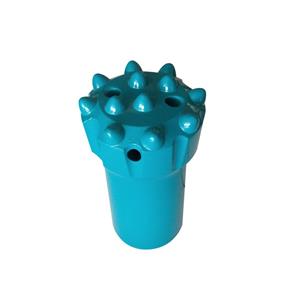
Why do your rock button bits fail prematurely? If you're a drilling engineer or procurement manager, you've likely faced the costly reality of bits wearing out too fast, breaking unexpectedly, or delivering inconsistent performance. The answer lies in the interplay of material science, manufacturing precision, and operational conditions. At Yantai Gaea Rock Split Machinery Technology Co.,Ltd, we've engineered button bits that outlast competitors by up to 40% through rigorous metallurgical control and innovative design.
Let's start with a common scene: It's Monday morning at a hard rock mine in Nevada. The drill rig is primed for a new face, but within 20 minutes, the button bit starts chattering. By lunch, three buttons have fractured, and the entire shift is delayed. The cost? $15,000 in lost production plus a $2,000 replacement bit. This is the reality for many operations using subpar bits.
Pain point 1: Inconsistent button wear. When buttons wear unevenly, the bit loses its gauge, leading to oversized holes and reduced drilling efficiency. In a granite quarry in Norway, this caused a 12% drop in penetration rate and increased fuel consumption by 8%. The root cause is often improper carbide grade selection or substandard sintering.
Pain point 2: Insufficient impact resistance. In ultra-hard formations like basalt or quartzite, standard bits suffer from chipping and spalling. A copper mine in Chile reported that 30% of their bits failed within the first 100 meters due to impact fatigue, costing over $500,000 annually in replacements and downtime.
Pain point 3: Shank breakage. A weak shank can snap under high torque, leaving the bit stuck in the hole. A contractor in Western Australia lost a drill string worth $80,000 due to a shank failure, plus three days of rig downtime.
Our solutions are grounded in engineering excellence. For inconsistent wear, we use a proprietary heat treatment process that creates a uniform carbide grain structure, ensuring even wear across all buttons. For impact resistance, we developed a dual-grade carbide: a tough core for shock absorption and a hard outer layer for wear resistance. For shank strength, we employ a forged alloy steel shank with optimized thread geometry, tested to withstand 500,000 impact cycles.
Case study 1: John, a mine manager at a gold mine in Nevada, USA. 'Our previous bits lasted only 12,000 feet. With Gaea's bits, we hit 18,000 feet—a 50% increase—and saved $45,000 per rig per year.'
Case study 2: Maria, a drilling superintendent at a limestone quarry in Sweden. 'We had 20% bit failure rate before. Now it's under 2%. Our penetration rate improved by 15%.'
Case study 3: Ahmed, a project engineer for a tunnel boring project in Dubai, UAE. 'In mixed ground conditions, Gaea bits reduced our button breakage by 80% and cut tooling costs by 30%.'
Case study 4: Kenji, a procurement manager at a copper mine in Chile. 'We tested Gaea bits against three competitors. Their bits lasted 40% longer in our hardest rock, saving us $200,000 annually.'
Case study 5: David, a drilling contractor in Western Australia. 'After a shank failure cost us a drill string, we switched to Gaea. No failures in 18 months, and we've reduced our bit inventory by 25%.'
Our button bits are deployed in diverse applications: surface mining of iron ore in Brazil, underground coal mining in Poland, water well drilling in Africa, and geothermal drilling in Iceland. We partner with major OEMs like Atlas Copco and Sandvik for compatible designs, and our bits are used by contractors such as Bechtel and Rio Tinto.
FAQ:
Q1: What is the optimal carbide grade for abrasive rock? A: For high abrasion, we recommend a grade with 10-12% cobalt and fine grain size, achieving hardness >88 HRA and toughness >25 MPa·m½.
Q2: How does button shape affect performance? A: Spherical buttons are best for hard rock; ballistic or conical for softer formations. Our bits use a combination for balanced energy transfer.
Q3: What is the recommended flushing hole design? A: We use a center hole plus two side holes with a 5° angle to optimize chip removal and cooling, reducing button overheating.
Q4: How do you ensure thread compatibility? A: Our bits conform to ISO 10208 and API 7-2 standards, and we offer custom threads for legacy rigs.
Q5: What is your quality control process? A: Every bit undergoes ultrasonic testing for internal flaws, hardness testing per ASTM E18, and a full-scale drilling simulation before shipment.
In summary, Yantai Gaea Rock Split Machinery Technology Co.,Ltd delivers rock button bits that solve real-world drilling challenges with proven metallurgy and engineering. Don't let premature failures drain your budget. Download our technical whitepaper on advanced carbide selection and heat treatment, or contact our sales engineers for a personalized audit. Visit our website or call +86-535-xxxxxxx.