Why Do Drill Rods Break So Often? Understanding the Forces Behind Failure
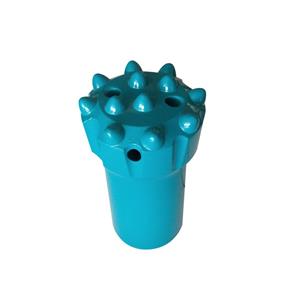
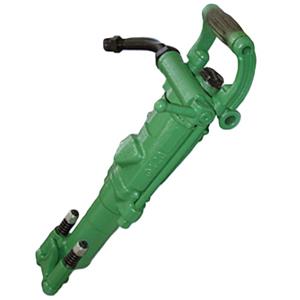
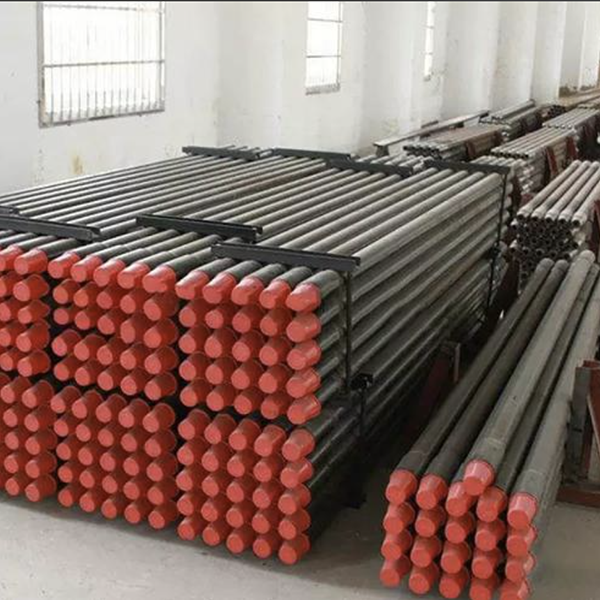
Thread drill rods, also known as jumbo drill rods or heavy-duty drill steels, connect the rock drill, shank adaptor, and drill bit. Their job is to transmit impact energy and rotary torque so the bit can break rock and create a borehole.
Because drilling takes place under complex and changing conditions, drill rods face repeated mechanical loading, abrasion from rock and cuttings, water-related corrosion, and additional stress from abnormal operating conditions. Understanding these loads is essential for selecting the right rock drilling tools, improving maintenance, and reducing unplanned downtime.
1. Alternating Axial Compression and Tension
During drilling, high-frequency impact energy travels from the rock drill through the shank adaptor and drill rod to the drill bit. When the bit strikes the rock, the rock mass creates resistance that travels back through the drill string.
This repeated cycle produces alternating compressive and tensile stress in the drill rod. Over time, the constant loading and unloading can lead to fatigue, cracking, reduced structural strength, and eventual rod failure. Material quality, heat treatment, thread condition, and correct operating practice all affect how well a drill rod withstands these cycles.
2. Radial Bending Stress
A drill rod is a long, slender component, which makes it more susceptible to bending stress than a short, rigid tool. Rod weight, minor misalignment, deviation in the hole, feed pressure, and off-centre impact can all introduce lateral forces.
Even slight bending affects energy transfer. Instead of delivering impact energy directly to the bit, the drill string loses efficiency through misalignment and vibration. Continued bending stress may cause permanent deformation, reduced drilling accuracy, thread damage, and a higher risk of unexpected breakage.
3. Rotary Torsional Stress
Rock drilling requires continuous rotation to support rock breaking and cuttings removal. As the rod rotates, it must overcome friction against the borehole wall, resistance from cuttings, and varying rock conditions.
This places the drill rod under torsional stress. A rod with insufficient torsional strength or toughness can twist, crack, or fail under demanding conditions. Reliable drilling therefore depends on matching rod specifications to the rock type, drilling equipment, hole diameter, and operating conditions.
4. Abrasion and Corrosion Inside the Borehole
Mechanical stress is only one part of the problem. During drilling, the rod surface is continuously exposed to abrasive rock fragments, borehole-wall contact, flushing media, and water impurities.
Rock debris can wear away the rod surface, while water and contaminants may gradually corrode the metal. Over time, abrasion and corrosion can reduce wall thickness, weaken threads, create surface defects, and shorten service life. Proper cleaning, inspection, lubrication where specified, and controlled storage are practical steps that help reduce this damage.
5. Combined Loads During Abnormal Operations
Special or abnormal conditions can create much higher combined loads than routine drilling. Examples include stuck tools, difficult retraction, excessive feed pressure, improper empty striking, ground support work, and other non-standard operations.
These conditions can combine bending, tension, compression, and torsion at the same time. For example, a stuck drill string may be exposed to excessive pulling force during recovery, while empty striking can leave impact energy with no effective rock-breaking path. Such conditions accelerate fatigue and make component failure more likely.
Improve Reliability Through Better Tool Management
A reliable drill rod programme should include:
Selecting rods with appropriate strength, toughness, torsional resistance, and corrosion resistance
Matching drilling tools to site geology and equipment capability
Monitoring rod straightness, thread condition, and visible wear
Avoiding excessive force and improper operating practices
Replacing damaged or heavily worn components before failure occurs
Training operators to recognise abnormal drilling conditions early
For projects involving rock excavation, quarrying, mining, tunnelling, or foundation work, drilling-tool condition has a direct impact on productivity, borehole quality, and job-site safety.
Alternative Rock-Breaking Considerations
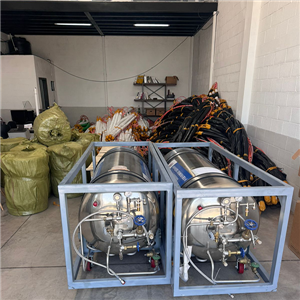
When conventional drilling and blasting methods face vibration limits, nearby structures, regulatory restrictions, or sensitive operating conditions, an engineered alternative may be worth evaluating. The Gaea Rock O2 Gas Energy Rock Splitting System uses rapid liquid-oxygen phase-change energy for controlled rock breaking rather than conventional explosive formulations.
Selection should always be based on site geology, project requirements, local regulations, qualified engineering review, and trained operation.