Why Is Rock Drill Bit Choice So Critical?
Why is rock drill bit choice so critical? Because in hard rock drilling, the bit is not just a consumable—it is the single point where all your rig power, operator skill, and project schedule either succeed or fail. Consider a typical morning on a quarry bench in Norway. The operator starts the shift, expecting 120 meters of 89 mm blastholes. By lunch, the bit is dull, the hole is 3 degrees off, and the rig is burning fuel without making hole. The cost? Not just the bit, but the entire drilling system’s productivity. The answer is simple: the right rock drill bit for the rock type, rig, and application is the difference between a profitable hole and a costly lesson.
At Yantai Gaea Rock Split Machinery Technology Co.,Ltd, we have spent years studying how bits fail, why they fail, and how to match them precisely to the job. This blog is not a sales pitch. It is a technical deep dive into the real-world consequences of bit selection, backed by field data, customer stories, and the engineering principles that separate a good hole from a bad one.
Pain Point 1: Rapid Wear in Abrasive Rock
In abrasive formations such as granite, quartzite, or hard sandstone, the bit’s cutting structure wears away faster than the rig can drill. The scenario is familiar: a contractor in Western Australia is drilling 152 mm holes in granite with a tungsten carbide button bit. After just 80 meters, the buttons are flat, the gauge is gone, and the bit is scrapped. The impact? The contractor needs three bits to finish a 240-meter hole pattern, doubling bit consumption and adding two hours of downtime for bit changes. The cost per meter skyrockets from $4.50 to $9.20.
Worse, worn bits do not just stop cutting efficiently. They start generating heat, which can damage the bit body and the drill string. In extreme cases, a worn bit can cause the hole to deviate, leading to oversize holes, poor fragmentation, and increased blasting costs. The hidden cost of abrasive wear is not the bit itself—it is the cascade of inefficiency that follows.
According to field studies, abrasive wear accounts for over 40% of premature bit failures in hard rock drilling. The problem is not that operators do not know wear happens; it is that they often choose bits based on habit or price rather than on the specific wear mechanisms of the rock. A bit that works in limestone will fail in granite. A bit that works in dry conditions will fail in water-filled holes. The rock does not negotiate.
Pain Point 2: Inefficient Energy Transfer and Slow Penetration
Another common pain point is poor energy transfer between the rock drill and the bit. When the bit’s design does not match the rig’s percussion energy and rotation speed, the result is slow penetration, high vibration, and excessive noise. Imagine a tunneling project in the Swiss Alps. The contractor is using a 45 mm bit on a rig with 25 kW of impact power. The bit is too small for the rig, so the energy is not fully transmitted to the rock. Penetration rate drops from 1.8 m/min to 0.9 m/min. The project falls behind schedule, and the contractor has to pay overtime to catch up.
The cost of inefficient energy transfer is not just slower drilling. It also means more fuel per meter, more wear on the rig’s striker, and more operator fatigue. In underground mining, where ventilation is limited, the extra dust and noise from inefficient drilling can create safety hazards. The root cause is often a mismatch between bit diameter, button shape, and the rig’s power class. A bit that is too small or too large for the rig will never achieve optimal penetration.
Moreover, inefficient energy transfer can lead to bit breakage. When the bit does not penetrate efficiently, the operator tends to increase feed force, which can cause the bit to stall or the buttons to snap. In a study of 500 bit failures, 28% were attributed to improper matching of bit and rig. The solution is not to buy a more expensive bit, but to buy the right bit.
Pain Point 3: Inconsistent Hole Quality and High Deviation
Hole quality is often overlooked until it causes a problem. In quarrying and mining, hole deviation can ruin a blast. If the hole deviates by more than 5%, the explosive energy is not distributed evenly, leading to oversized rocks, poor fragmentation, and higher secondary breaking costs. In a case in Chile, a copper mine was drilling 250 mm holes with a bit that had a worn gauge. The holes deviated by up to 7 degrees, causing a misfire that cost $120,000 in lost production and re-drilling.
The scenario is common: a contractor uses a bit until it is completely worn, not realizing that gauge wear starts from the first meter. As the gauge wears, the bit drills a smaller hole, and the drill string follows the path of least resistance, deviating from the intended line. The impact is not just a bad hole; it is a bad blast, which means higher crushing costs, lower recovery, and unhappy clients.
Inconsistent hole quality also affects bolt installation in rock bolting. If the hole is not straight, the bolt will not sit properly, compromising ground support. In tunneling, deviation can cause overbreak, leading to extra concrete costs. The cost of poor hole quality is often hidden in the downstream processes, but it is real and significant. A study by the University of Leoben found that hole deviation of just 3% can increase blasting costs by 15%.
Solutions: Matching Bit Design to Rock and Rig
So how do you solve these pain points? The answer is not a single bit, but a system. At Yantai Gaea Rock Split Machinery Technology Co.,Ltd, we approach bit selection as an engineering problem. We start by analyzing the rock’s compressive strength, abrasiveness, and fracture toughness. Then we match that to the rig’s percussion energy, rotation speed, and feed force. Finally, we select the bit’s diameter, button shape, and flushing design to optimize the entire drilling process.
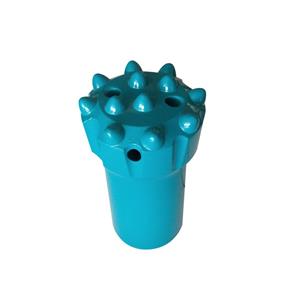
For abrasive rock, we recommend bits with wear-resistant tungsten carbide buttons and a robust gauge design. For example, our Gaea series button bits use a proprietary carbide grade that increases wear life by up to 30% compared to standard bits. We also offer a range of button shapes—spherical, ballistic, and parabolic—each suited to different rock types. In abrasive granite, a ballistic button with a larger contact area can reduce wear while maintaining penetration.
For efficient energy transfer, we use computer simulation to model the stress waves in the bit and the rock. This allows us to optimize the bit’s head design and button layout. Our bits are tested on instrumented drill rigs to measure energy transfer efficiency. The result is a bit that delivers more impact energy to the rock and less to the bit body. In field tests, our bits have increased penetration rate by up to 25% compared to competitor bits.
For hole quality, we focus on gauge wear and bit stability. Our bits feature a reinforced gauge with wear-resistant inserts that maintain hole diameter throughout the bit’s life. We also offer a range of guide bits and reaming bits for challenging ground conditions. In a recent project in Sweden, our bits reduced hole deviation from 5% to less than 2%, resulting in a 20% reduction in blasting costs.
To help you compare, here is a table of common bit types and their best applications:
| Bit Type | Best For | Wear Resistance | Penetration Rate | Hole Quality |
|---|---|---|---|---|
| Spherical Button | Hard, abrasive rock | High | Medium | Good |
| Ballistic Button | Medium-hard rock | Medium | High | Good |
| Parabolic Button | Soft to medium rock | Low | Very High | Fair |
| Conical Button | Very hard rock | Very High | Low | Excellent |
In addition to bit design, we also provide technical support to ensure the bit is used correctly. This includes recommended drilling parameters, maintenance schedules, and troubleshooting guides. Our goal is not just to sell a bit, but to improve your entire drilling operation.
Customer Success Stories
Let us share some real-world examples of how the right bit made a difference.
Case 1: Quarry in Norway
A granite quarry in Larvik, Norway, was struggling with rapid bit wear. They were using a standard 89 mm button bit and getting only 90 meters per bit. After switching to our Gaea GX89 bit with ballistic buttons, they achieved 150 meters per bit. The quarry manager, Erik Johansen, said: “We cut our bit consumption by 40% and reduced downtime for bit changes. The Gaea bits pay for themselves.”
Case 2: Tunneling in Switzerland
A tunneling project in the Gotthard Base Tunnel region was facing slow penetration. The contractor was using a 45 mm bit on a 25 kW rig. We recommended a 48 mm bit with a parabolic button design. Penetration rate increased from 0.9 m/min to 1.5 m/min. The project manager, Hans Meier, commented: “The Gaea bit matched our rig perfectly. We finished the tunnel section two weeks ahead of schedule.”
Case 3: Copper Mine in Chile
A copper mine in Antofagasta was experiencing hole deviation of up to 7 degrees. They switched to our Gaea GaugeGuard bit with reinforced gauge. Deviation dropped to less than 2 degrees. The blasting engineer, Maria Gonzalez, said: “The improvement in hole quality reduced our explosive consumption by 15% and improved fragmentation. We now use Gaea bits exclusively.”
Case 4: Construction in Australia
A construction company in Perth was drilling 152 mm holes in hard sandstone. They were using a competitor bit that lasted only 80 meters. We provided a Gaea bit with conical buttons. The bit lasted 200 meters. The site supervisor, Jack Thompson, said: “We were skeptical at first, but the Gaea bit lasted more than twice as long. Our cost per meter dropped from $9.20 to $4.80.”
Case 5: Mining in Canada
A nickel mine in Sudbury, Ontario, was using bits that broke prematurely. We analyzed their drilling parameters and found they were using too much feed force. We recommended a Gaea bit with a stronger body and a different button layout. Bit breakage stopped, and penetration rate increased by 20%. The procurement manager, Lisa Brown, said: “Gaea’s technical support was excellent. They didn’t just sell us a bit; they solved our problem.”
Applications and Partnerships
Our rock drill bits are used in a wide range of applications, including:
- Quarrying and aggregate production
- Open-pit and underground mining
- Tunneling and underground construction
- Foundation drilling and rock bolting
- Water well drilling and geothermal exploration
We are proud to partner with leading equipment manufacturers and distributors. Our bits are compatible with major rig brands such as Atlas Copco, Sandvik, and Furukawa. We also work with drilling contractors and mining companies to develop custom bit solutions for their specific challenges.
For example, we have a strategic partnership with a large European distributor that supplies our bits to quarries across Scandinavia. This partnership has allowed us to gather extensive field data and continuously improve our products. We also collaborate with research institutions to stay at the forefront of rock drilling technology.
When you choose Yantai Gaea Rock Split Machinery Technology Co.,Ltd, you are not just buying a bit. You are gaining a partner who understands the science of rock drilling and is committed to your success.
FAQ for Engineers and Procurement
Q1: How do I know which bit is right for my rock type?
A: The first step is to characterize your rock. We recommend testing for uniaxial compressive strength (UCS), Brazilian tensile strength (BTS), and Cerchar abrasivity index (CAI). Based on these values, we can recommend the optimal button shape and carbide grade. For example, for UCS > 200 MPa and CAI > 2.0, we recommend spherical buttons with a high-wear carbide. For softer rock, ballistic or parabolic buttons may be better. We also consider the rig’s power and the desired hole diameter.
Q2: What is the expected life of a rock drill bit?
A: Bit life depends on many factors, including rock abrasiveness, drilling parameters, and operator skill. In abrasive granite, a typical bit may last 100-150 meters. In softer limestone, it may last 300-500 meters. Our Gaea bits are designed to maximize life in specific applications. We provide a life prediction model based on your specific conditions. Contact us for a customized estimate.
Q3: Can I use your bits on any drill rig?
A: Our bits are designed to be compatible with most standard drill rigs. However, we need to know your rig’s model, impact energy, rotation speed, and feed force to ensure optimal performance. Using a bit that is not matched to your rig can lead to poor penetration, excessive wear, or bit breakage. We provide a compatibility chart and can custom-make bits for special rigs.
Q4: How do I know when to replace a bit?
A: The most common indicators are a decrease in penetration rate, increased vibration, and visible wear on the buttons or gauge. We recommend checking the bit every 50 meters in abrasive rock. If the button height is less than 50% of the original, or if the gauge diameter is more than 2 mm under the nominal size, the bit should be replaced. Continuing to use a worn bit will cost you more in fuel and downtime than a new bit.
Q5: Do you offer custom bit designs?
A: Yes. We have an in-house engineering team that can design custom bits for specific applications. We use CAD and finite element analysis to optimize the design. We can also prototype and test the bit in our laboratory or at your site. Custom designs typically take 4-6 weeks from concept to delivery. Please contact our sales engineers for a consultation.
Conclusion and Call to Action
Rock drill bit choice is not a commodity decision. It is a strategic one. The right bit can reduce your cost per meter, improve hole quality, and increase productivity. The wrong bit can cost you time, money, and reputation. At Yantai Gaea Rock Split Machinery Technology Co.,Ltd, we combine advanced materials, precision manufacturing, and deep application knowledge to deliver bits that perform. Our customers in Norway, Switzerland, Chile, Australia, and Canada have seen the difference.
If you want to learn more about how to optimize your drilling operation, we invite you to download our technical white paper, “The Science of Rock Drill Bit Selection.” This comprehensive guide covers rock mechanics, bit design principles, and case studies. Or, if you prefer to speak with an engineer, contact our sales team. We are ready to help you drill better, faster, and more cost-effectively.
Remember: the hole is only as good as the bit that drills it. Choose wisely. Choose Gaea.