Why Tapered Button Bits Use a Pre-Enlarged Design
Why Tapered Button Bits Use a Pre-Enlarged Design
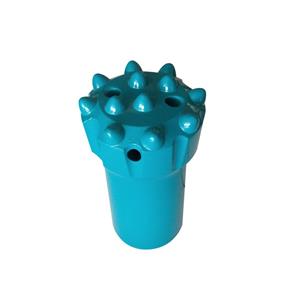
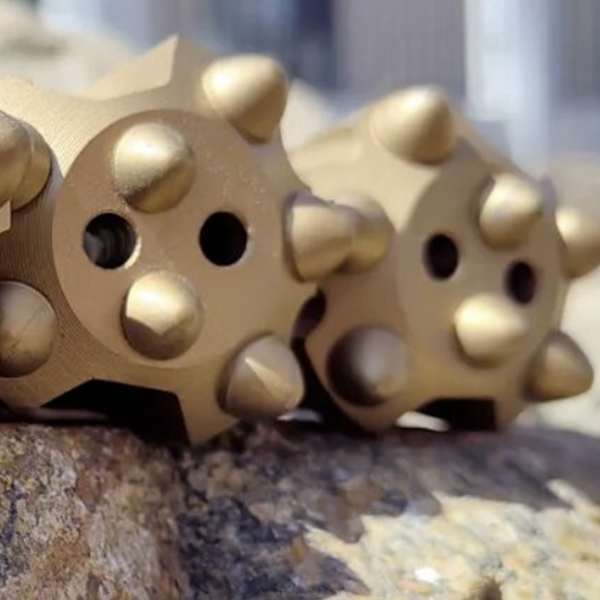
Tapered button bits, also known as tapered shank spherical button bits, follow a widely used pre-enlargement design principle. Their actual outside diameter at delivery is normally 0.5 to 1.0 mm larger than the nominal diameter. This is intentional design allowance rather than a machining error.
For example, a tapered button bit with a nominal diameter of 36.0 mm may have an actual new diameter of at least 36.5 mm, with some products approaching 37.0 mm.
The Purpose of Pre-Enlargement
Tapered button bits experience relatively rapid wear during the early stage of drilling. The carbide buttons and the steel skirt can wear quickly during the first several meters of drilling, causing the outside diameter to decrease.
If the bit were manufactured exactly at the nominal diameter, early wear could make the hole diameter fall below the design requirement. By adding 0.5 to 1.0 mm in advance, the design compensates for early wear and helps maintain a hole diameter closer to the required standard throughout the bit’s service life.
This approach helps prevent the common problem of the hole gradually becoming smaller as drilling continues.
Nominal Diameter Is Not the Final Hole Diameter
Even when a bit is manufactured with a pre-enlarged diameter, the final hole diameter is affected by several external factors. The nominal bit size and actual drilled-hole diameter should therefore not be regarded as exactly identical.
Both product design and field construction should allow a reasonable dimensional range.
Main Factors Affecting Hole Size
Rock hardness and abrasiveness have a direct effect on bit wear. Hard, highly abrasive formations can accelerate wear and cause the final hole diameter to become smaller.
Drilling parameters also influence the result. Higher rock-drill impact pressure and rotational speed may produce a larger hole diameter, depending on the equipment and rock conditions.
Geological structure is another important factor. Broken rock and well-developed joints may cause hole-wall collapse, resulting in an irregular hole diameter. In such cases, the final deviation is influenced not only by bit wear but also by surrounding-rock stability.
Practical Design and Construction Considerations
Pre-enlargement balances the initial bit size with performance over the full service life. It provides useful allowance for early wear, but it cannot replace proper selection of drilling parameters or evaluation of geological conditions.
When planning drilling work, users should consider nominal bit diameter, pre-enlargement range, expected wear, rock hardness and abrasiveness, impact pressure, rotational speed, and hole-wall stability. These factors should be combined to establish a reasonable tolerance range for the actual drilled-hole diameter.