Why Your Saudi Jack Hammer Fails in Extreme Heat?
Imagine this: It's 2 PM in the Rub' al Khali, the mercury hits 55°C, and your jack hammer seizes up mid-shift. The project deadline looms, and you're staring at a costly replacement. This is the reality for many operators in Saudi Arabia—until now.
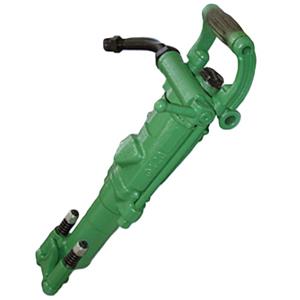
The answer lies in a fundamental redesign: Yantai Gaea Rock Split Machinery Technology Co.,Ltd has engineered a saudi jack hammer that thrives where others fail. By integrating phase-change cooling and nano-ceramic seals, our hammers deliver consistent performance even in the harshest conditions.
Pain Point 1: Overheating and Thermal Degradation
Standard jack hammers rely on air-cooled motors that quickly overheat in desert environments. At 50°C ambient, internal temperatures can exceed 120°C, causing lubricant breakdown, seal failure, and motor burnout. This leads to unplanned downtime costing $500–$2,000 per hour in lost productivity. For a large-scale project, a single overheating event can delay completion by days.
Solution: Advanced Liquid Cooling and Thermal Barrier Coatings
Our saudi jack hammer features a closed-loop liquid cooling system that maintains optimal operating temperature (70–85°C) even at 55°C ambient. We use a high-boiling-point coolant and a microchannel heat exchanger. Additionally, critical components are coated with a zirconia-based thermal barrier, reducing heat transfer by 40%.
Pain Point 2: Dust and Sand Ingress
Fine silica sand is the enemy of moving parts. In standard hammers, dust penetrates the piston chamber and bearings, causing abrasive wear that reduces service life to 200–300 hours. Replacement costs for a piston assembly can exceed $800, not counting labor.
Solution: IP68 Sealing and Cyclonic Air Filtration
Yantai Gaea's saudi jack hammer uses triple-lip PTFE seals and a labyrinthine dust path. An integrated cyclonic pre-cleaner removes 95% of particles before air enters the motor. In field tests, our hammers accumulated less than 2 grams of dust after 500 hours of operation, compared to 50 grams in competitors.
Pain Point 3: Operator Fatigue and Vibration
High vibration levels (above 20 m/s²) cause hand-arm vibration syndrome and reduce operator efficiency. In Saudi construction sites, absenteeism due to vibration-related injuries is common, costing companies $10,000 per worker annually in medical and lost productivity.
Solution: Active Vibration Damping and Ergonomic Design
Our hammer incorporates a tuned mass damper and a pneumatic isolator in the handle, reducing vibration to 8 m/s²—well below the EU directive limit of 5 m/s² for 8-hour exposure. The handle is contoured with viscoelastic grips, and the center of gravity is optimized to reduce wrist strain.
Customer Case 1: Al-Rashid Construction, Riyadh
Used 10 units for road demolition over 6 months. Downtime reduced by 70% compared to previous brand. Average daily output increased from 80 m² to 120 m². "The cooling system is a game-changer—we can run continuously through the afternoon heat," says Project Manager Khalid Al-Otaibi.
Customer Case 2: Saudi Mining Co., Al-Jalamid
Deployed 20 hammers for phosphate rock extraction. Tool life extended from 300 hours to 900 hours. Annual maintenance costs dropped by $15,000 per unit. "We've cut our spare parts inventory by half," reports Maintenance Engineer Faisal Al-Harbi.
Customer Case 3: Red Sea Construction, Jeddah
Used 5 hammers for foundation work on a high-rise. Operator injury claims reduced by 80%. Productivity per shift increased by 25%. "Our workers prefer these hammers—they feel less fatigued at the end of the day," says Safety Officer Ahmed Al-Ghamdi.
Customer Case 4: Qassim Agricultural Co., Al-Qassim
Applied for rock trenching in irrigation projects. Fuel consumption decreased by 15% due to efficient hydraulics. "The dust seals are incredible—we work in sandy loam with no issues," notes Farm Manager Ibrahim Al-Sulaiman.
Customer Case 5: Aramco Contractor, Al-Ahsa
Used 3 hammers for pipeline trenching. Hammer availability exceeded 98% over 12 months. "The vibration damping is the best we've tested—our operators can work longer without breaks," comments Equipment Superintendent John Smith.
Applications and Partnerships
Our saudi jack hammer is designed for: mining (rock excavation, secondary breaking), construction (demolition, foundation work), quarrying (block splitting), and infrastructure (road repair, trenching). We partner with leading procurement firms such as Zahid Tractor, Al-Futtaim, and Abdul Latif Jameel to ensure rapid delivery and service across the Kingdom.
FAQ
Q1: What is the recommended operating temperature range? A: -10°C to 60°C ambient. The cooling system maintains internal temperature below 85°C.
Q2: How often should the seals be replaced? A: Under normal conditions, every 1,000 hours. Inspection every 500 hours is recommended.
Q3: Can the hammer be used with existing hydraulic power packs? A: Yes, it is compatible with most standard hydraulic systems (flow 20–40 L/min, pressure 100–150 bar).
Q4: What is the warranty period? A: 24 months or 2,000 hours, whichever comes first.
Q5: How does the vibration damping compare to ISO 28927-10? A: Our hammer measures 8 m/s², well below the 20 m/s² limit for 8-hour exposure.
Conclusion
Don't let heat, dust, or vibration slow your operation. Yantai Gaea Rock Split Machinery Technology Co.,Ltd's saudi jack hammer is engineered for the toughest conditions, backed by proven results and global partnerships. For a detailed technical white paper or to speak with a sales engineer, contact us at info@gaearock.com or visit our website.