Chile's Mining Boom Meets a Safety Crisis: Can the O2 Rock Blasting System Help?
Chile's Historic Copper Expansion in 2026
Chile is entering what many industry analysts call a "golden window." As the world's largest copper producer, the country has announced the fast-tracking of 13 major copper projects worth a combined USD 14.8 billion, all targeting key milestones throughout 2026. This massive investment wave is driven by surging global copper demand — fueled by the energy transition, electric vehicle manufacturing, and AI infrastructure buildout — which has pushed copper prices to multi-year highs.
The project list reads like a who's who of global mining:
Freeport-McMoRan's El Abra expansion — USD 7.5 billion to significantly boost throughput at one of Chile's largest open-pit copper mines in the Antofagasta region
Codelco's Chuquicamata Underground (Mina Norte) — EUR 800 million in new contracts awarded to STRABAG/ZUBLIN for underground mine development at what was once the world's largest open-pit copper mine
Codelco's Ministro Hales extension — USD 2.8 billion approved to extend operations through 2054 with enhanced capacity
Antofagasta Minerals' growth pipeline — USD 3.4 billion in 2026 capital expenditure across multiple expansion projects
Collahuasi's C20+ optimization — one of seven operations hitting key development milestones this year
The new Kast government, which took office in March 2026, has signaled its intent to accelerate mining investment through regulatory reform. As Mining Minister Carlos Mas stated in April 2026: "We are trying to increase investment to assure the expansion of some mines."
But There's a Problem: Safety and Regulation Are Tightening Simultaneously
While investment is pouring in, Chile's mining sector faces a parallel and increasingly urgent challenge: safety enforcement is becoming dramatically stricter.
The El Teniente Wake-Up Call
On July 31, 2025, a magnitude 4.3 seismic event triggered a catastrophic rock burst at Codelco's El Teniente mine — the world's largest underground copper mine, located in the Andes south of Santiago. The collapse killed six workers and injured several others, making it the deadliest mining accident in Chile in over a decade.
The aftermath has been swift and far-reaching:
Codelco and its contractors were fined over USD 100,000 by Chilean labor authorities
Codelco announced fast-tracked automation across its operations to reduce human exposure in high-risk zones
Chile's mining safety fines were increased to up to 100 annual tax units (approximately USD 71,000 per violation) under updated 2026 regulations
Investigations continue — regulators indicate the probe into root causes will take months, potentially leading to further operational restrictions
This tragedy has fundamentally reshaped the conversation around mining safety in Chile. Every project on that USD 14.8 billion list must now demonstrate not just economic viability, but an uncompromising commitment to worker safety — particularly in underground operations where rock fragmentation and ground control are daily challenges.
Permitting Delays Compound the Pressure
It is not just safety regulations that are creating friction. A recent investigation by Mining Technology found that permitting delays — not geology — are the primary factor stalling Chile's mining investment. Regulatory uncertainty and institutional fragmentation have created approval timelines that can stretch for years.
For operations involving explosive materials, the permitting burden is even heavier. Chile's strict regulations on the storage, transport, and use of industrial explosives require multiple agency approvals, specialized facilities, and ongoing compliance monitoring — all of which add time and cost to project timelines that are already under pressure.
A New Aggregate Extraction Law
Chile recently enacted Law No. 21,800, the country's first comprehensive nationwide framework for aggregate extraction. This new law introduces additional permitting and environmental requirements for quarrying and rock material extraction — processes that rely heavily on blasting operations. Mining companies operating quarries for construction aggregate or road base material now face an additional layer of regulatory compliance.
The Rock Blasting Dilemma in Chilean Mining
Here is the core challenge facing Chile's mining sector in 2026: you need to break more rock than ever before, but the tools for doing so are under increasing regulatory and safety scrutiny.
Conventional explosive blasting — using dynamite, ANFO, or emulsion explosives — remains the standard method for large-scale rock fragmentation in Chilean mines. However, it carries inherent risks that are now squarely in the spotlight:
Seismic triggering: While the El Teniente collapse was triggered by a natural seismic event, conventional blasting generates its own seismic waves that can destabilize surrounding rock mass — a critical concern in Chile's seismically active mining regions
Toxic fumes: Blasting produces nitrogen oxides, carbon monoxide, and particulate matter, creating air quality concerns especially in underground operations where ventilation is limited
Fly rock and misfires: Uncontrolled fragmentation can endanger workers, damage equipment, and require costly secondary breaking
Permitting complexity: Each explosive use requires compliance with Chile's military-grade explosive handling regulations, including secure storage, licensed operators, and transport documentation
The O2 Rock Blasting System: A Solution Built for Chile's New Reality
The O2 Gas Energy Rock Splitting System (Liquid Oxygen Rock Blasting System) offers a fundamentally different approach to rock fragmentation — one that directly addresses the safety, regulatory, and operational challenges now dominating Chile's mining landscape.
How It Works
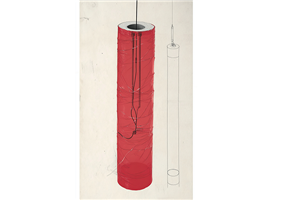
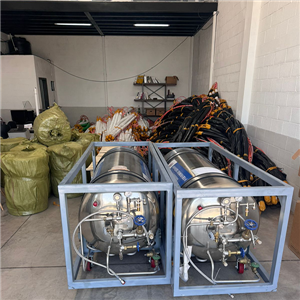
The system uses liquid oxygen (LOX) as the oxidizer, injected into specialized paper splitting tubes placed in pre-drilled boreholes. Upon activation, the liquid oxygen rapidly vaporizes and expands approximately 860 times its volume, generating controlled pressure that fractures rock along designed planes. The chemical reaction produces only water vapor and carbon dioxide — no toxic gases, no particulate matter.
Why It Matters for Chilean Mining Operations
1. No Explosive Permits Required
This is potentially the single biggest advantage in Chile's current regulatory environment. The O2 system's components — liquid oxygen and paper splitting tubes — are classified as ordinary industrial materials, not explosives. No military-grade handling permits, no secure ammunition storage facilities, no licensed blasters. For mining companies already navigating Chile's complex permitting landscape, eliminating the explosive licensing burden can save months of approval time and significantly reduce compliance costs.
2. Minimal Safety Exclusion Zone: 2-3 Meters
Conventional blasting in open-pit mines typically requires exclusion zones of 200-500 meters. In Chile's increasingly safety-conscious environment, this means halting multiple work areas during every blast cycle. The O2 system maintains a safety perimeter of just 2-3 meters, allowing adjacent drilling, hauling, and processing operations to continue uninterrupted. For a large-scale operation like Freeport's El Abra or Codelco's Chuquicamata, this translates directly into higher operational continuity and throughput.
3. No Blast-Induced Seismic Risk
The El Teniente collapse has put seismic risk at the top of every mine manager's priority list in Chile. Unlike conventional explosives, the O2 system's energy release is contained within the borehole, producing no significant seismic waves. In a country that experiences regular seismic activity, eliminating blast-induced ground vibration is not just a safety improvement — it is a risk management imperative.
4. Cost: Approximately USD 1 per Cubic Meter
At roughly USD 1 per cubic meter, the O2 system is cost-competitive with or cheaper than conventional explosives (typically USD 1.2 to USD 3 per cubic meter), even before accounting for the indirect savings from reduced permitting, eliminated blast downtime, and lower compliance overhead. A single 20GP container provides material for approximately 37,500 cubic meters of rock fragmentation, while a 40HQ container handles up to 131,250 cubic meters — making logistics straightforward for remote Andean mining operations.
5. Proven in Underground Mining Conditions
Chile's copper industry is increasingly moving underground as surface deposits are depleted. The Chuquicamata Underground project, the El Teniente expansion, and several of the 13 fast-tracked projects all involve underground or transition mining. The O2 system has been validated in underground conditions where conventional blasting poses the greatest risks: confined spaces, limited ventilation, and proximity to workers.
6. Environmentally Compliant
With Chile's new aggregate extraction law (Law No. 21,800) adding environmental requirements and the government signaling tighter sustainability standards, the O2 system's zero-toxic-emission profile provides a natural compliance advantage. No NOx, no carbon monoxide, no harmful particulates — only water vapor and CO2 that can be safely ventilated from underground operations.
Chile Mining: The Numbers in Context
Chile currently produces approximately 27% of the world's mined copper — over 5.5 million tonnes annually. The 13 projects fast-tracked for 2026 represent a combined investment of USD 14.8 billion, and the government has signaled that 25 additional mining projects across copper, gold, lithium, and cobalt are open for international investment.
Codelco alone is undertaking structural transformations worth tens of billions of dollars to maintain its position as the world's leading copper producer. Freeport-McMoRan, Antofagasta Minerals, Anglo American, BHP, and Rio Tinto all have major expansion programs active in Chile this year.
Every one of these operations requires rock fragmentation. Every one faces the same safety and regulatory pressures. The market opportunity for a safer, simpler, and cost-effective alternative to conventional explosives is substantial and growing.
Beyond Chile: A Regional Solution
Chile's challenges are shared across Latin America's mining belt. Peru consolidated its position as the world's second-largest copper producer in 2025 with 2.77 million tonnes of fine copper. Colombia has launched tenders for 14 strategic copper regions. The same safety concerns, permitting delays, and environmental requirements that are reshaping Chilean mining are appearing throughout the region.
The O2 system — already established with distribution partners in South America — offers a unified solution that can scale across these markets.
Conclusion
Chile stands at a pivotal moment in its mining history. The USD 14.8 billion copper expansion represents an unprecedented opportunity, but the El Teniente tragedy and subsequent regulatory tightening have made one thing clear: the old approaches to rock fragmentation carry risks that the industry can no longer accept.
The O2 Rock Blasting System does not ask mining companies to compromise on productivity. It delivers effective rock fragmentation at competitive costs — while eliminating explosive permits, reducing safety exclusion zones from hundreds of meters to three, producing zero toxic emissions, and generating no blast-induced seismic risk.
For mining executives, project managers, and procurement officers navigating Chile's 2026 mining landscape, the O2 system deserves serious evaluation — not as an experimental alternative, but as a proven technology aligned with the direction the industry is heading.