How the O2 Rock Blasting System Solves NEOM's Rock Excavation Challenges — A Safer, Cost-Effective Alternative
NEOM's Monumental Rock Excavation Challenge
Saudi Arabia's NEOM — the crown jewel of Vision 2030 — represents the most ambitious construction undertaking in modern history. Spanning 26,500 km² across the Tabuk Province in northwestern Saudi Arabia, this $500 billion giga-project encompasses multiple zones: The LINE, Trojena, Magna, and Oxagon, each presenting extraordinary engineering demands.
But beneath the architectural vision lies a formidable geological reality: massive rock excavation on an unprecedented scale.
According to recent geotechnical reports from Geoengineer.org, NEOM's construction has mobilized 260 excavators and 2,000 trucks operating around the clock just for land clearing and foundation preparation. The LINE alone — a 170-km linear corridor rising 500 meters — requires foundation work through some of Saudi Arabia's most complex terrain. Meanwhile, Magna's development involves hollowing out entire mountains to create an integrated luxury resort, and Trojena's mountainous terrain demands specialized rock stabilization techniques.
This is not ordinary excavation. This is rock breaking at a scale the construction industry has rarely seen — and it comes with equally massive challenges.
The Hidden Costs of Traditional Explosive Blasting
For most large-scale rock excavation projects, conventional explosive blasting (dynamite, ANFO, or emulsion explosives) has been the default method for decades. However, NEOM's unique requirements expose the critical limitations of this approach:
1. Strict Saudi Explosives Regulations
Saudi Arabia maintains rigorous controls over the procurement, transport, storage, and use of industrial explosives. The Saudi Aramco GI 475.001 Rock Blasting Near Existing Structures standard mandates comprehensive pre-blast surveys, detailed geological assessments, and structural integrity checks before any blasting operation. For a project of NEOM's complexity — with multiple active construction zones, existing infrastructure, and workers in proximity — the permitting process alone can cause significant project delays.
2. Safety Risks in Multi-Zone Construction
NEOM is not a single construction site — it's a constellation of simultaneous projects. Trojena's mountain resort development, Magna's underground excavation, and The LINE's foundation work all proceed in parallel. Traditional explosives create exclusion zones of 200-500 meters, meaning blasting in one area halts work in adjacent zones. With 2,000 trucks and 260 excavators in continuous operation, these shutdowns translate directly into lost productivity and blown timelines.
3. Seismic and Structural Concerns
Northwestern Saudi Arabia sits in a seismically active region near the Gulf of Aqaba transform fault. Geotechnical engineers implementing real-time ground monitoring systems at NEOM must account for blast-induced vibrations that could compromise slope stability, particularly in Trojena's mountainous terrain where unstable rock formations already require specialized reinforcement. Conventional explosives generate seismic waves that can trigger landslides or destabilize adjacent excavation faces.
4. Environmental Compliance
Vision 2030 positions NEOM as a model of sustainable development. Traditional explosives produce nitrogen oxides (NOx), carbon monoxide, and other toxic fumes — emissions that conflict directly with NEOM's environmental commitments and Saudi Arabia's increasingly stringent air quality standards.
Enter the O2 Rock Blasting System: Engineered for Projects Like NEOM
The O2 Gas Energy Rock Splitting System (also known as the Liquid Oxygen Rock Blasting System) represents a fundamental paradigm shift in rock fragmentation technology — one particularly well-suited to the challenges NEOM presents.
How It Works
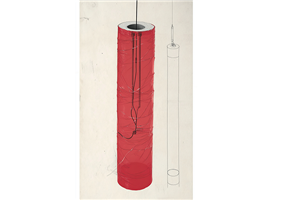
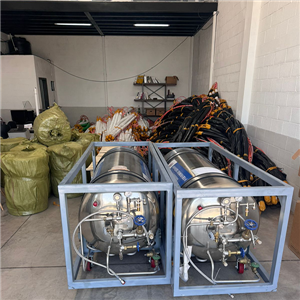
The system uses liquid oxygen (LOX) as the oxidizer, injected into specialized paper splitting tubes placed in pre-drilled boreholes. The liquid oxygen rapidly vaporizes and expands approximately 860 times its volume, generating controlled pressure that fractures rock along designed fracture planes. The byproducts? Only water (H₂O) and carbon dioxide (CO₂) — completely non-toxic gases.
Why It's a Game-Changer for NEOM-Scale Projects
? No Explosive Permits Required
Unlike dynamite or ANFO, the O2 system's components — liquid oxygen and paper splitting tubes — are classified as ordinary cargo for transport and storage. No explosive licensing, no specialized secure storage facilities, no armed transport requirements. This alone can save weeks of permitting time on a project where schedule adherence is critical.
? Minimal Safety Exclusion Zone: Only 2-3 Meters
This is perhaps the most significant advantage for a multi-zone project like NEOM. While conventional explosives require 200-500 meter exclusion zones, the O2 system maintains a safety perimeter of just 2-3 meters. Excavation in one zone can proceed while workers, equipment, and even structures remain active in adjacent areas. For a project running 2,000 trucks and 260 excavators simultaneously, this eliminates the cascading downtime that plagues conventional blasting schedules.
? Cost: Approximately $1 per Cubic Meter
The O2 system is competitive with or cheaper than convention alexplosives(1.2–$3/m³), even before factoring in the indirect cost savings from reduced permitting time, eliminated exclusion zone shutdowns, and simplified logistics. A single 20GP container holds enough material for approximately 37,500 m³ of rock fragmentation, and a 40HQ container can handle up to 131,250 m³.
? Zero Toxic Emissions
The reaction produces only water vapor and CO₂. No NOx, no carbon monoxide, no harmful particulates. For a project that has committed to the highest environmental standards under Vision 2030, this is not a minor consideration — it's a compliance necessity.
? Works in Water-Saturated Conditions
NEOM's coastal zones and underground excavation areas frequently encounter groundwater. The O2 system's paper splitting tubes are compatible with water-filled boreholes, making them effective in conditions where conventional explosives require costly dewatering operations.
? Controlled Energy Release
Unlike the chaotic fragmentation of conventional explosives, the O2 system produces uniform, predictable rock breakage with consistent fragment sizes. This reduces secondary breaking requirements and produces aggregate material that is more readily usable for on-site construction purposes — valuable when you're building an entire city from scratch.
Practical Application: A NEOM Scenario
Consider a typical excavation challenge at NEOM: a section of hard rock terrain requiring 50,000 m³ of controlled removal near an active construction zone.
With Conventional Explosives:
Permitting process: 2-4 weeks
Safety exclusion zone: 200+ meters (halting adjacent work)
Blast vibration monitoring required
Toxic fumes require ventilation/dispersion waiting period
Cost estimate: 60,000–150,000 for explosives alone
With the O2 Rock Blasting System:
No explosive permits needed — immediate mobilization
Safety exclusion zone: 2-3 meters (adjacent work continues)
No blast vibration concerns
Zero toxic emissions — no waiting period
Cost estimate: ~$50,000 for LOX and splitting tubes
Logistics: approximately 2 x 20GP containers
The result: Faster mobilization, no workflow interruption, lower direct costs, and full environmental compliance.
Real-World Validation
The O2 system is not theoretical — it's proven in demanding field conditions across multiple continents:
Southeast Asian quarries — High-volume aggregate production in tropical conditions
South American mining operations — Large-scale ore fragmentation in copper and gold mines
Urban demolition projects — Safe rock breaking within meters of occupied buildings
Underwater applications — Effective rock fragmentation in fully submerged conditions
Each of these scenarios has validated the system's core promise: effective rock fragmentation without the regulatory burden, safety compromises, and environmental impact of conventional explosives.
Conclusion
As NEOM and Saudi Arabia's giga-projects continue to push the boundaries of construction engineering, the tools and methods used must evolve accordingly. The O2 Rock Blasting System offers a compelling proposition: achieve the same rock fragmentation results as conventional explosives, but without the permitting delays, safety exclusion zones, toxic emissions, and regulatory complexity.
For project managers, procurement officers, and construction executives working on NEOM and similar mega-projects across the Middle East and South America, the O2 system deserves serious consideration — not as a theoretical alternative, but as a proven, field-validated solution ready for deployment.