Peru's Copper Mining Expansion in 2026: How the O2 Rock Blasting System Reduces Costs and Compliance Risks
Peru's Mining Sector Is Scaling Up — Again
Peru is the world's second-largest copper producer, extracting approximately 2.77 million tonnes of copper annually. The country's mining sector accounts for roughly 10% of GDP and over 60% of export revenue, making it the backbone of Peru's economy.
And in 2026, the sector is growing — not through a single mega-project, but through a broad-based expansion across multiple operations and regions.
Key developments driving demand for rock fragmentation in Peru right now:
Major mining companies are reinvesting in existing operations, extending mine lives and expanding pit limits as copper prices remain elevated above USD 4.00 per pound
Multiple copper projects are advancing through permitting and pre-production phases, each requiring significant overburden removal and access road construction
Underground mining operations are increasing as surface deposits mature, creating demand for tunnel development and underground rock excavation
Peru's government is actively promoting mining investment through streamlined permitting for strategic minerals, positioning the country to capitalize on global demand for copper driven by the energy transition
Every tonne of copper produced requires, on average, 3-5 tonnes of rock to be moved — whether in open-pit operations, underground development, or road and infrastructure construction. At Peru's scale, that translates to tens of millions of cubic meters of rock fragmentation annually.
The question for mining companies is not whether they need to break rock. It is how to do it most efficiently, safely, and profitably.
The Explosive Blasting Bottleneck in Peruvian Mining
Peru's mining industry has relied on conventional explosive blasting for decades. ANFO, emulsion explosives, and dynamite are standard tools across the country's operations. But as operations scale up, the limitations of this approach are becoming increasingly costly.
1. Peru's Explosive Regulations Are Complex and Time-Consuming
Peru's Ministry of the Interior, through the National Superintendency of Police Controls (SUCAMEC), regulates the entire lifecycle of industrial explosives — from manufacturing and importation to storage, transport, and use. Mining companies must maintain dedicated explosive magazines at each operation, staffed by licensed personnel, with rigorous inventory controls and reporting requirements.
For exploration and pre-production projects — where operations are temporary and mobile — the cost of establishing compliant explosive storage and transport infrastructure can be disproportionate to the scale of rock-breaking work required. This creates a significant barrier for junior mining companies and contractors working on smaller projects.
2. Remote Operations Face Explosive Supply Challenges
Many of Peru's most promising copper deposits are located in remote, high-altitude regions of the Andes — the Apurimac, Cusco, and Ancash departments, where altitudes exceed 3,000 meters above sea level and access roads are limited.
Transporting explosives to these sites involves specialized licensed carriers, security escorts, and route restrictions that add both cost and time. In some cases, weather-related road closures can delay explosive deliveries by days or weeks, bringing excavation programs to a standstill.
3. Environmental Compliance Costs Are Rising
Peru's mining sector operates under intense environmental scrutiny — from communities, NGOs, and the government. The Ministry of Energy and Mines (MINEM) and the Agency for Environmental Assessment and Enforcement (OEFA) enforce strict standards for blast vibration, air quality, and water contamination.
Conventional explosives produce nitrogen oxides, carbon monoxide, and fine particulates that require monitoring, mitigation, and reporting. Communities near mining operations are increasingly assertive about environmental impacts, and even minor violations can trigger regulatory sanctions, operational delays, or community protests that halt production entirely.
4. Underground Mining Amplifies Every Problem
As more of Peru's copper production shifts underground, the challenges of explosive blasting intensify. Underground operations require:
Smaller blast patterns with precise fragmentation control
Ventilation systems to clear blast fumes before workers can re-enter
Stringent vibration monitoring to protect underground infrastructure
Closer proximity between active blast zones and occupied areas
Each of these factors increases the cost and complexity of explosive-based rock breaking underground.
The O2 Rock Blasting System: Built for Mining Conditions Like Peru's
The O2 Gas Energy Rock Splitting System (Liquid Oxygen Rock Blasting System) is designed to provide effective rock fragmentation without the regulatory burden, supply chain complexity, and environmental risks of conventional explosives — a combination that is particularly valuable in Peru's mining context.
How It Works
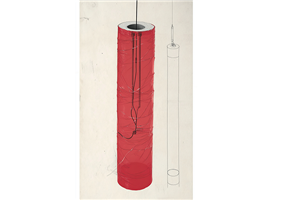
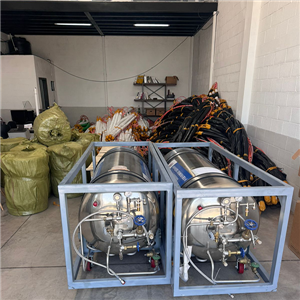
The system uses liquid oxygen (LOX) as the energy source. Specialized paper splitting tubes are placed in pre-drilled boreholes, and liquid oxygen is injected from a refillable gas filling tank. When remotely triggered, the liquid oxygen rapidly vaporizes and expands approximately 860 times its volume, generating controlled pressure that fractures rock.
The byproducts are water vapor and CO₂ only — zero toxic gases, zero harmful particulates.
Why Mining Companies in Peru Should Consider the O2 System
No Explosive Permits Required
The O2 system's components — liquid oxygen and paper splitting tubes — are classified as ordinary cargo. No SUCAMEC licensing is required for purchase, transport, or storage. No dedicated explosive magazines. No licensed explosive handlers. No specialized security transport.
For exploration teams, junior mining companies, and contractors working on smaller-scale projects in Peru, this eliminates an entire layer of regulatory overhead and cost. You can mobilize rock-breaking equipment to a remote site without establishing a compliant explosive supply chain first.
For major operations, the O2 system serves as a supplementary tool — deployed in sensitive zones, near communities, or during periods when explosive supply is disrupted — without requiring separate permitting or infrastructure.
2-3 Meter Safety Zone
Conventional explosives require exclusion zones of 200-500 meters in open-pit operations and strict inter-panel clearances underground. The O2 system operates with a safety perimeter of just 2-3 meters, enabling simultaneous operations in adjacent areas.
In underground mining, where tunnel development faces are often just meters apart, this compact safety zone allows parallel advance on multiple headings — significantly accelerating development timelines.
Cost: Approximately USD 1 per Cubic Meter
At roughly USD 1 per cubic meter, the O2 system offers meaningful cost savings compared to conventional explosives, which typically cost between USD 1.20 and USD 3.00 per cubic meter in Peru's remote mining locations (where logistics surcharges are significant).
A single 40HQ container holds enough material for approximately 131,250 cubic meters of rock fragmentation. The logistics are simple: standard container shipping, no special handling, no licensed carriers.
Zero Toxic Emissions
No NOx. No carbon monoxide. No harmful fumes. This is not just an environmental benefit — it is an operational advantage. Without blast fumes to clear, workers can re-enter excavation areas immediately. In underground operations, this eliminates the ventilation wait time that follows every conventional blast cycle, effectively increasing productive mining hours.
Works in Water-Filled Boreholes
Peru's high-altitude mining operations frequently encounter groundwater in boreholes, particularly during the rainy season (November to March). The O2 system's splitting tubes function effectively in fully water-saturated conditions, eliminating the need for dewatering operations that delay conventional explosive loading.
70% Less Shockwave
Independent monitoring by China's Changjiang River Scientific Research Institute (CRSRI) has confirmed that the O2 system generates approximately 70% less shockwave pressure than emulsion explosives, with faster seismic wave attenuation. This is critical for:
Protecting underground infrastructure (ventilation shafts, pump stations, electrical installations)
Reducing vibration impact on nearby communities — a growing source of social conflict at Peruvian mines
Maintaining pit wall stability in open-pit operations near final pit limits
Practical Mining Applications in Peru
Open-Pit Mine Expansion
As copper prices drive pit expansion at established operations like Las Bambas, Antamina, Cerro Verde, and Toromocho, overburden removal and pushback operations require millions of cubic meters of rock fragmentation. The O2 system can supplement conventional explosives in zones near pit limits, haul roads, or community boundaries — where vibration and environmental concerns make explosives difficult to use.
Underground Tunnel Development
Peru's underground mines require kilometers of development headings annually. The O2 system's precise fragmentation and compact safety zone make it well-suited for decline development, ramp construction, and lateral heading advance — particularly near existing underground infrastructure.
Exploration Access
Exploration programs in Peru's remote Andean regions often require road construction and trench excavation through hard rock. The O2 system's simple logistics — standard container transport, no explosive permits, no specialized storage — make it the ideal tool for remote access development where establishing a conventional explosive supply chain is impractical.
Community-Sensitive Operations
Peru's mining conflicts frequently center on blast vibration, noise, and environmental contamination. The O2 system's low vibration, zero toxic emissions, and minimal noise offer a technical solution that can help mining companies maintain their social license to operate in areas where community opposition has previously halted operations.
The Case for O2 Blasting in Peru's Mining Future
Peru's copper mining sector is entering a period of sustained growth, driven by strong copper prices, government support for mining investment, and accelerating global demand for copper in the energy transition. But this growth comes against a backdrop of increasing regulatory complexity, community scrutiny, and environmental enforcement.
Mining companies that can break rock more efficiently, with lower regulatory risk, lower environmental impact, and lower community opposition will have a measurable competitive advantage — not just in Peru, but across South America's mining landscape.
The O2 Rock Blasting System is not a replacement for conventional explosives in every application. But as a strategic complement — deployed where explosives face regulatory, environmental, or community constraints — it offers a proven, field-validated solution that directly addresses the challenges Peru's mining sector faces in 2026 and beyond.
For mining companies operating in Peru, the O2 system deserves a place in the rock-breaking toolbox. The economics work, the science is validated, and the operational advantages are immediate.