Oman Is Building at a Pace Not Seen in Decades
The Sultanate of Oman is undergoing a transformation that is reshaping the entire Gulf construction landscape. Driven by Vision 2040, a rapidly growing population, and an aggressive diversification strategy away from hydrocarbon dependence, Oman's construction and mining sectors are expanding at a remarkable rate.
Consider the scale of what is happening right now:
USD 15 billion in mineral development projects are either under way or in the bidding phase, spanning marble quarrying, limestone extraction, copper mining, and chromite production
9,600 new hotel rooms are set to open by 2030, with 2,600 already completed or nearing completion, adding more than 25% to Oman's existing 36,000-room inventory
Major port and logistics expansions at Duqm, Sohar, and Salalah are being fast-tracked as Dubai reroutes cargo through Omani ports in response to the ongoing Strait of Hormuz disruptions
Population growth of 4.5% annually is fueling domestic demand for housing, roads, hospitals, and commercial infrastructure
The construction sector grew by 3.6% in 2025, and industry analysts project continued acceleration through 2026 and beyond. The tourism sector alone is expected to contribute 5% to GDP by 2030 and 10% by 2040, overtaking transport and logistics as Oman's second most important industry after hydrocarbons.
Every one of these projects has something in common: they require rock excavation, quarrying, or controlled demolition.
And that is where the bottleneck lives.
The Explosive Blasting Problem in Oman
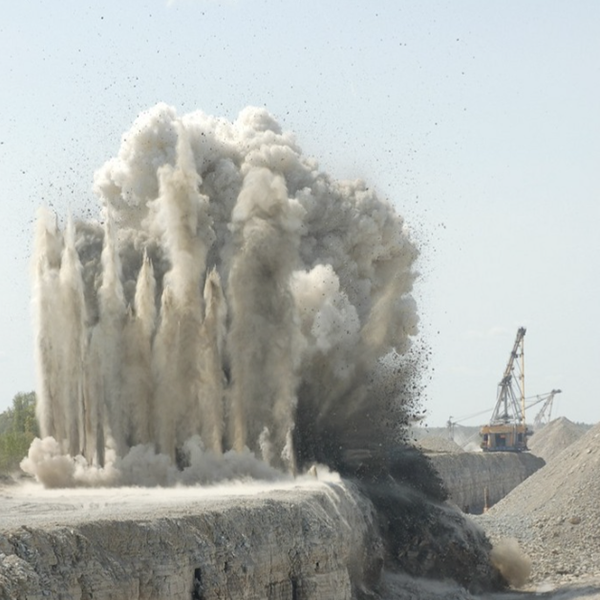
Oman's geology is dominated by hard sedimentary rock formations — limestone, sandstone, and ophiolite sequences — that are excellent for construction aggregate but extremely tough to break. For decades, the go-to solution has been conventional explosive blasting with dynamite, ANFO, or emulsion explosives.
But in 2026, the limitations of this approach are becoming impossible to ignore.
1. Oman's Explosive Regulations Are Tightening
Oman's Royal Oman Police (ROP) and the Ministry of Commerce and Industry enforce strict controls over the procurement, transport, storage, and use of industrial explosives. Contractors must obtain multiple permits — for purchase, transport, storage at licensed magazines, and on-site use. The permitting process can take weeks, and any delay in documentation cascades directly into project timelines.
For international contractors working on Oman's growing portfolio of projects, this regulatory complexity is a significant operational hurdle. Add to this the fact that explosive storage facilities must meet military-grade security standards, and the logistics overhead becomes a serious cost center.
2. Environmental Sensitivity Is a Growing Factor
Oman has committed to ambitious environmental targets under Vision 2040. The country's coastline, mountain ranges, and desert ecosystems are subject to increasing environmental protection measures. Traditional explosives produce nitrogen oxides (NOx), carbon monoxide, and fine particulate matter — emissions that are increasingly scrutinized by Oman's environmental regulators.
Projects near populated areas, protected zones, or tourism development sites face additional environmental impact assessments when using conventional explosives, adding both time and cost.
3. Proximity Challenges in Urban and Tourism Zones
Muscat's urban expansion, Salalah's tourism corridor, and new developments like A'Thuraya City — a sustainable luxury development that "embraces nature while prioritizing sustainability and smart design" — all involve rock excavation near existing structures, residential areas, or environmentally sensitive sites.
Conventional explosives create exclusion zones of 200-500 meters, meaning every blast operation forces a halt to all nearby construction activity. For projects operating on tight timelines with multiple subcontractors, these shutdowns are expensive and disruptive.
4. Water-Saturated Ground Conditions
Many of Oman's coastal construction sites, including areas around Duqm, Sohar, and Salalah, involve groundwater-saturated rock formations. Conventional explosives require costly dewatering operations before use in wet boreholes, adding significant expense and time to excavation programs.
The O2 Rock Blasting System: Purpose-Built for Oman's Conditions
The O2 Gas Energy Rock Splitting System (Liquid Oxygen Rock Blasting System) addresses every one of these challenges — and does so at a lower cost per cubic meter than conventional explosives.
How It Works
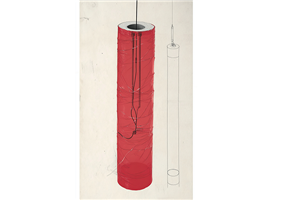
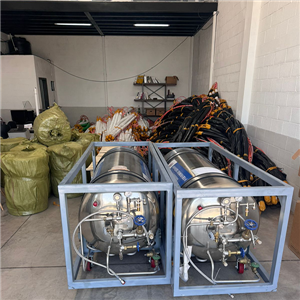
The system uses liquid oxygen (LOX) as the energy source. Specialized paper splitting tubes are placed in pre-drilled boreholes, and liquid oxygen is injected from a refillable gas filling tank. When remotely triggered, the liquid oxygen rapidly vaporizes and expands approximately 860 times its volume, generating controlled pressure that fractures rock along designed planes.
The reaction byproducts are only water vapor and carbon dioxide — completely non-toxic, zero harmful emissions.
Why O2 Blasting Is Ideal for Oman's Construction Projects
No Explosive Permits, No Storage Headaches
The O2 system's components — liquid oxygen and paper splitting tubes — are classified as ordinary cargo. No explosive licensing is required for purchase, transport, or storage. No military-grade secure storage facilities. No armed transport. This eliminates weeks of permitting time and dramatically reduces logistics costs.
For contractors bidding on Oman's growing pipeline of projects, the ability to mobilize rock-breaking equipment immediately, without waiting for explosive permits is a genuine competitive advantage.
2-3 Meter Safety Zone vs. 200-500 Meters
While conventional explosives require massive exclusion zones, the O2 system operates with a safety perimeter of just 2-3 meters. This means excavation can proceed in one area while construction, surveying, or even residential activity continues just meters away.
For projects like A'Thuraya City, Salalah's tourism developments, or any construction near Muscat's expanding urban footprint, this compact safety zone is transformative. No more shutting down half your site for every blast cycle.
Cost: Approximately USD 1 per Cubic Meter
At roughly USD 1 per cubic meter, the O2 system is 20-65% cheaper than conventional explosives, which typically cost between USD 1.20 and USD 3.00 per cubic meter. A single 40HQ container holds enough material for approximately 131,250 cubic meters of rock fragmentation — enough to sustain a large-scale quarry operation for weeks.
When you factor in the indirect savings — no permitting delays, no exclusion zone shutdowns, no specialized transport, no secure storage — the total cost advantage becomes even more significant.
Zero Toxic Emissions
Water vapor and CO₂ are the only byproducts. No NOx, no carbon monoxide, no harmful dust or fumes. For projects operating under Oman's increasingly stringent environmental standards, the O2 system offers a straightforward path to compliance — without sacrificing rock-breaking performance.
Works in Water-Filled Boreholes
The O2 system's splitting tubes are designed to function in fully water-saturated boreholes, making them ideal for Oman's coastal construction sites and groundwater-rich areas. No dewatering operations required — just drill, load, and fire.
Low Vibration, Protecting Nearby Structures
The O2 system generates approximately 70% less shockwave than conventional explosives. Independent monitoring by China's Changjiang River Scientific Research Institute (CRSRI) has confirmed that the system's seismic wave attenuation is faster than emulsion explosives, meaning vibrations dissipate more quickly and pose less risk to adjacent structures. This is critical for urban construction in Muscat, renovation projects near heritage sites, and quarry operations near communities.
Application Scenarios in Oman
Mineral Development and Quarrying
Oman's USD 15 billion mineral investment program involves extensive quarrying of marble, limestone, and gypsum — all materials used in the country's booming construction sector. The O2 system produces uniform, consistent rock fragmentation with predictable fragment sizes, reducing secondary breaking requirements and improving aggregate quality.
For quarry operators supplying material to Oman's hotel construction, road building, and port expansion programs, the O2 system offers higher throughput, lower costs, and simpler regulatory compliance.
Port and Infrastructure Construction
Dubai's decision to reroute cargo through Oman's ports has triggered urgent infrastructure expansion at Duqm, Sohar, and Salalah. Port expansion requires massive rock excavation for breakwaters, berths, and land reclamation — often in coastal areas with high water tables.
The O2 system's ability to operate in water-saturated conditions and its minimal environmental impact make it the ideal choice for these marine construction applications.
Tourism Development
With 9,600 new hotel rooms planned by 2030 and tourism expected to reach 10% of GDP by 2040, Oman's tourism development corridor — particularly around Salalah, Musandam, and the Al Hajar mountains — requires extensive rock work for resort foundations, access roads, and landscaping. The O2 system's low vibration and compact exclusion zone allow construction to proceed without disrupting the natural environment that makes these locations attractive in the first place.
Urban Construction in Muscat
Muscat's population is growing 4.5% annually, driving demand for residential towers, commercial complexes, hospitals, and schools. The O2 system's proximity safety — working within meters of existing structures — makes it invaluable for foundation excavation, basement construction, and site preparation in dense urban environments.
Oman's Moment — And the Tool to Seize It
Oman is not just growing — it is positioning itself as the Gulf's next major construction market. The convergence of Vision 2040 investment, population growth, tourism expansion, and the strategic reconfiguration of Gulf logistics is creating a sustained demand for construction services that will extend well beyond 2030.
For contractors and quarry operators working in Oman, the question is not whether rock excavation will be needed — it is how to do it faster, cheaper, safer, and in compliance with Oman's evolving regulatory and environmental standards.
The O2 Rock Blasting System answers that question with proven field performance, authoritative third-party validation, and a cost structure that outperforms conventional explosives on every metric that matters.