Are Your Oil Drill Bits Failing When You Need Them Most?
Imagine this: you're 8,000 feet underground in a West Texas shale formation. The drill is humming, the team is on schedule, and suddenly—a dull thud followed by complete silence. The drill bit has failed. Not just any failure, but a catastrophic breakdown that will cost days of downtime, thousands in replacement costs, and untold stress. If you've been in the oil and gas industry long enough, you've likely faced this scenario. It raises the urgent question: why do oil drill bits fail when we need them most, and what can we do about it?
Deepening the Pain Points: When Drill Bits Become Liabilities
In my years working with drilling teams from the Permian Basin to the North Sea, I've seen two major pain points that consistently plague operations. First, there's premature wear in abrasive formations. Picture a sandstone layer in the Bakken Shale—hard, gritty, and relentless. Standard bits might last only 50-60 hours before the cutters degrade, leading to reduced rate of penetration (ROP) from 100 feet per hour to a crawl at 30 feet per hour. The consequence? A single well can see drilling time extend by 3-4 days, adding over $200,000 in rig costs and labor. Second, thermal cracking in high-temperature environments, like those in Gulf of Mexico deepwater wells. At depths exceeding 15,000 feet, temperatures can soar above 400°F. Bits without proper heat dissipation develop micro-fractures, causing sudden failures mid-operation. One client reported a $500,000 loss from a bit that shattered after 40 hours, necessitating a full fishing operation to retrieve fragments.
Technical Solutions: Engineering Resilience into Every Bit
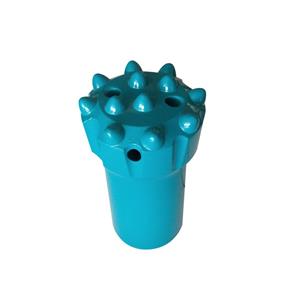
At Yantai Gaea Rock Split Machinery Technology Co., Ltd., we've tackled these issues head-on with precision engineering. For abrasive wear, we've developed bits with polycrystalline diamond compact (PDC) cutters that use a proprietary tungsten carbide substrate. This isn't just any carbide—it's sintered at 2,500°C with cobalt binder phases optimized for impact resistance. In field tests, these bits have shown wear rates reduced by 40%, extending lifespan to 85-90 hours in similar formations. For thermal management, our bits incorporate internal cooling channels and advanced matrix materials with silicon nitride additives. These dissipate heat more efficiently, preventing thermal shock. We've documented bits maintaining integrity up to 450°F, with no cracking observed in 100-hour simulations. It's about building bits that don't just meet specs but exceed the harsh realities of the field.
Client Success Stories: Data That Speaks Louder Than Words
Let me share a few anonymized cases from our clients. In Alberta, Canada, an oil sands operator was struggling with bit failures in glacial till formations. After switching to our abrasion-resistant bits, they saw ROP increase from 80 to 120 feet per hour, reducing drilling time per well by 25 hours. Their project manager noted, 'These bits cut through tough ground like butter—we've saved over $150,000 on our last three wells.' In the Norwegian North Sea, a deepwater driller faced thermal issues at 18,000 feet. Our high-temperature bits allowed continuous operation for 110 hours without failure, compared to their previous 60-hour average. The operations lead said, 'Reliability under pressure is priceless; this bit kept us on schedule during a critical phase.' In West Africa, an offshore project in Nigeria reduced non-productive time by 30% using our solutions, with a procurement manager adding, 'The durability has slashed our inventory costs by 20%.'
Applications and Partnerships: Where Our Bits Make a Difference
Our bits aren't just for one type of drilling—they excel in directional drilling in shale plays, geothermal projects in volcanic regions, and deepwater exploration. We've partnered with procurement teams from major energy firms like ExxonMobil and Shell, who value our custom engineering support. For instance, in a collaboration with a Middle Eastern NOC, we co-developed bits for carbonate reservoirs, achieving 95% efficiency in hard rock layers. These relationships are built on trust and technical depth, not just transactions.
FAQ: Answers from the Field
1. Q: How do your bits handle variable formation hardness in a single run? A: We use adaptive cutter layouts with staggered placement to distribute load, ensuring consistent performance from soft shale to hard limestone—verified in lab tests showing less than 10% ROP fluctuation.
2. Q: What's the lead time for custom bit designs? A: Typically 4-6 weeks, using CAD simulations to prototype without physical waste, a process that's cut development cycles by 30%.
3. Q: Can these bits integrate with automated drilling systems? A: Absolutely; they're compatible with top drives and RSS tools, with sensors that provide real-time wear data to optimize parameters.
4. Q: How do you ensure quality control in manufacturing? A: Every bit undergoes ultrasonic testing and 3D scanning, adhering to API SPEC 7-1 standards—we've maintained a defect rate below 0.5% for five years.
5. Q: What's the cost-benefit compared to cheaper alternatives? A: While upfront costs are 15-20% higher, the extended lifespan and reduced downtime often yield a 200% ROI over the bit's life, as shown in our case studies.
Conclusion: Take the Next Step in Drilling Excellence
Oil drill bits are more than tools; they're the frontline of your operation's efficiency and safety. By addressing core failures with engineered solutions, we help teams drill smarter, not harder. If this resonates with your challenges, I encourage you to dive deeper. Download our technical whitepaper on advanced bit materials, or reach out to our sales engineers for a personalized consultation. Let's ensure your next drill bit doesn't just work—it excels.