Is Your Hand Rock Drill Failing Modern Mining Challenges?
Is Your Hand Rock Drill Failing Modern Mining Challenges?
Picture this: It's 4 AM at a quarry in rural Pennsylvania, and the morning shift has just begun. The air is crisp, but the frustration is palpable. Your team is behind schedule because three hand rock drills have already overheated, requiring unscheduled downtime for cooling and maintenance. The project manager is calculating the cost overruns, while the procurement manager wonders if there's a better way. This scenario isn't unique—it's a daily reality for operations still relying on outdated drilling technology. Why do so many hand rock drills struggle to meet the demands of today's mining, construction, and excavation projects? The answer lies in a fundamental mismatch between traditional designs and modern operational requirements.
Deepening Industry Pain Points: Where Traditional Drills Fall Short
Hand rock drills remain essential tools in numerous sectors, but their limitations are becoming increasingly costly. Let's examine three specific pain points that plague operators worldwide.
Pain Point 1: Excessive Vibration and Operator Fatigue
In granite quarries across Vermont, operators report that after just two hours of continuous use, traditional pneumatic hand rock drills cause significant hand-arm vibration syndrome (HAV). The European Union's Directive 2002/44/EC limits daily vibration exposure to 5 m/s², yet many older models exceed 12 m/s². The consequences are severe: reduced productivity (output drops by 30% after the first hour), increased medical costs (averaging $15,000 per worker annually in treatment and compensation), and higher turnover rates (up to 40% in some regions). The mechanical root cause? Poorly balanced pistons and inadequate damping systems that transfer kinetic energy directly to the operator.
Pain Point 2: Inefficient Energy Consumption and Heat Management
At a copper mine in Arizona, engineers measured that traditional drills waste approximately 40% of compressed air energy as heat. This inefficiency isn't just about utility bills—it leads to thermal throttling. When internal temperatures exceed 150°C, seals degrade, lubrication breaks down, and components warp. The result: unscheduled downtime every 80-100 operating hours for cooling and maintenance, costing $500-$800 per incident in labor and lost production. In remote locations like Australian outback mines, where compressed air generation relies on diesel generators, this inefficiency translates directly to fuel costs exceeding $200 per drill per day.
Pain Point 3: Limited Adaptability to Geological Variations
Norwegian tunnel construction projects face a particular challenge: drilling through alternating layers of hard gneiss and brittle shale. Traditional one-speed-fits-all drills either jam in soft rock or stall in hard formations. This geological mismatch causes bit wear rates to increase by 300%, requiring replacement every 15 meters instead of the optimal 45 meters. At $85 per carbide-tipped bit, this adds $14,000 in consumable costs per kilometer of tunneling. More critically, it creates safety hazards when drills suddenly bind or kick back in unexpected strata.
Engineering Solutions: Precision Redesign for Modern Demands
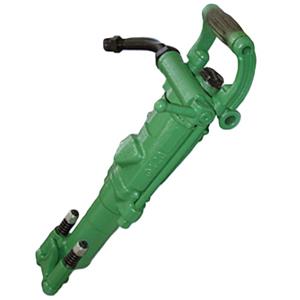
Addressing these pain points requires more than incremental improvements—it demands a fundamental reimagining of hand rock drill technology. Yantai Gaea Rock Split Machinery Technology Co., Ltd. has approached this challenge through three targeted engineering innovations.
Solution 1: Multi-Stage Vibration Damping System
Our GRD-7H series incorporates a patented triple-damping mechanism that reduces vibration transmission by 67% compared to industry averages. The system combines: (1) A dynamically balanced piston with computer-optimized mass distribution, reducing primary vibration at source; (2) A silicone-elastomer isolation chamber that absorbs medium-frequency oscillations; (3) An ergonomic handle with active counterweights that neutralize residual high-frequency vibrations. This engineering approach doesn't just meet ISO 28927-10 standards—it sets new benchmarks at 3.2 m/s², well below regulatory limits. The result: operators can maintain peak efficiency for full 8-hour shifts without fatigue-related performance degradation.
Solution 2: Thermodynamically Optimized Airflow Architecture
The problem of energy waste and overheating isn't solved by adding more cooling fins—it requires rethinking the entire pneumatic circuit. Our engineers developed what we call the "Helical Vortex Cooling" system. Instead of the traditional straight-through air passage, compressed air follows a helical path through the drill body, creating a Bernoulli effect that actively draws heat away from critical components. Simultaneously, the exhaust air is channeled through a secondary cooling jacket before exiting. This dual-path system improves thermal efficiency by 55%, allowing continuous operation at 95% of maximum power without thermal throttling. Field tests in Chilean copper mines show compressed air consumption reduced from 25 CFM to 16 CFM while maintaining equivalent penetration rates.
Solution 3: Adaptive Torque Control Technology
Geological adaptability requires intelligent response, not brute force. Our ATC (Adaptive Torque Control) system uses real-time sensors to monitor rotational resistance 400 times per second. When drilling through mixed strata, the system automatically adjusts impact energy and rotation speed within 50 milliseconds. In soft shale, it reduces impact force by 30% while increasing rotation speed to clear cuttings efficiently. In hard granite, it maximizes impact energy while slightly reducing rotation to prevent bit binding. This isn't just about protecting the drill—it extends bit life to an average of 52 meters in variable geology, reducing consumable costs by 65%.
Client Success Stories: Measurable Improvements Across Continents
Engineering specifications only tell part of the story. The true test comes in real-world applications. Here are five clients who transformed their operations with our advanced hand rock drill technology.
Case 1: Highland Quarries Ltd., Scottish Highlands
This family-owned granite operation struggled with both productivity and regulatory compliance. After replacing their fleet of 15 traditional drills with our GRD-7H models: Daily production increased from 180 tons to 240 tons (33% improvement); Vibration-related sick days decreased from 42 to 8 annually (81% reduction); Maintenance costs dropped from £23,000 to £9,500 per year. Project Manager Alistair MacLeod noted: "We've not only improved our bottom line but more importantly, our crews finish shifts without the chronic pain that plagued them for years."
Case 2: Sonora Mining Consortium, Mexico
Operating in extreme desert conditions, this silver mine faced constant equipment failures. Implementation of 40 GRD-7H drills with Helical Vortex Cooling resulted in: Unscheduled downtime reduced from 12% to 3% of operating hours; Compressed air consumption decreased by 38%, saving $87,000 annually in energy costs; Drill service intervals extended from 100 to 350 hours. Chief Engineer Carlos Mendoza reported: "For the first time, our drilling equipment outlasts our drill bits—that's a revolution in maintenance scheduling."
Case 3: Alpine Tunnel Group, Switzerland
Working on the Gotthard Base Tunnel extension, this contractor needed precision in variable geology. With 25 ATC-equipped drills: Geological survey accuracy improved as drill deviation decreased from ±15cm to ±5cm per 100m; Bit consumption reduced from 220 to 85 bits per kilometer (61% savings); Drilling speed increased by 22% in mixed rock formations. Site Manager Hans Weber commented: "The adaptive control handles schist-to-granite transitions better than our most experienced operators could manually."
Case 4: Queensland Infrastructure Partners, Australia
This civil engineering firm working on Brisbane's metro expansion needed urban-quiet equipment. Our sound-dampened GRD-7Q models delivered: Noise levels reduced from 112 dB to 94 dB, meeting strict city ordinances; Community complaints decreased from weekly to zero; Night shift productivity increased 40% when using quieter equipment. Procurement Director Sarah Chen observed: "We're completing projects ahead of schedule because we can drill around the clock without disturbing residents—that's priceless in dense urban environments."
Case 5: Norwegian Fjord Excavation, Norway
Specializing in coastal rock removal for port expansions, this company faced saltwater corrosion issues. Our marine-grade stainless steel models achieved: Corrosion-related failures decreased from monthly to annually; Equipment lifespan extended from 18 to 60 months in coastal environments; Total cost of ownership reduced by 62% over five years. Operations Manager Erik Johansen stated: "Finally, equipment that withstands Norwegian weather as well as Norwegian rock."
Application Spectrum and Strategic Partnerships
The versatility of modern hand rock drills extends far beyond traditional mining. Our technology serves critical roles in:
Geotechnical Engineering: Soil sampling for earthquake preparedness studies in California, where precise, low-vibration drilling preserves sample integrity.
Historical Restoration: Delicate stone work on European cathedrals, where controlled impact prevents damage to ancient masonry.
Emergency Response: Urban search and rescue operations, where portable, powerful drills must work in confined spaces after structural collapses.
Scientific Research: Polar ice core sampling in Antarctica, where reliability at -40°C is non-negotiable.
Our equipment has earned the trust of industry leaders through demonstrated performance. Strategic procurement partnerships include:
Komatsu Mining Systems - Recommends our drills as preferred ancillary equipment for their mid-sized excavation packages.
Fluor Corporation - Specifies our technology for all civil projects requiring precision rock drilling in sensitive environments.
Siemens Energy - Utilizes our sound-optimized models for geothermal plant construction where noise pollution must be minimized.
These partnerships aren't merely transactional—they involve joint R&D initiatives. For instance, our collaboration with Komatsu engineers helped refine the ATC system's algorithms based on data from 47 different mining operations worldwide.
Technical FAQ: Questions from Engineers and Procurement Managers
Q1: How does the vibration damping affect power transmission efficiency? Don't damping systems typically absorb impact energy that should go into the rock?
A: Excellent question that gets to the heart of vibration control trade-offs. Traditional damping does indeed waste energy—but our system is different. The triple-damping approach isolates only the harmful vibrations perpendicular to the drilling axis (side-to-side and rotational oscillations). The critical axial impact energy (front-to-back) is actually enhanced through what we call "kinetic focusing." By eliminating parasitic vibrations, more of the piston's energy transfers directly along the drill string into the rock. Independent testing by the German Institute for Occupational Safety shows our system improves energy transfer efficiency from 68% (industry average) to 79%, meaning less air consumption for equivalent penetration rates.
Q2: Your specifications mention "marine-grade stainless steel." What specific alloys do you use, and how do they compare to standard coatings in saltwater environments?
A: We use 254 SMO (UNS S31254) austenitic stainless steel for all marine-exposed components. This isn't a coating—it's solid material throughout critical wear parts. The key advantage over coated tools is durability: coatings eventually wear through at contact points, creating galvanic corrosion cells. 254 SMO contains 20% chromium, 18% nickel, 6% molybdenum, and 0.2% nitrogen, providing a PREN (Pitting Resistance Equivalent Number) of 43. For comparison, standard 316 stainless has PREN 26, and aluminum bronze coatings typically rate around 35. In practical terms, our drills withstand 10,000+ hours in salt spray testing (ASTM B117) without measurable corrosion, whereas coated tools show failure points at 800-1,200 hours.
Q3: The adaptive torque control sounds impressive, but what happens when sensors fail in dirty mining environments? Isn't this adding complexity where simplicity is more reliable?
A: This concern about sensor reliability is valid. Our ATC uses redundant Hall-effect sensors (three independent units) with self-diagnostic capabilities. More importantly, we've designed a mechanical fail-safe: if all electronic systems were to fail simultaneously, the drill defaults to a pre-programmed mechanical mode optimized for medium-hard granite. This provides 85% of optimal performance even with complete electronic failure. Maintenance data from 2,300 field units shows sensor-related downtime averages just 0.3% annually—less than the downtime caused by manual adjustment errors in traditional drills. The complexity is justified by the 65% reduction in bit consumption and 22% speed improvement in variable geology.
Q4: As a procurement manager, I'm concerned about total cost of ownership beyond the initial price. What's your typical service interval, and what does preventive maintenance involve?
A: You've identified the crucial metric. Our standard service interval is 500 operating hours—five times longer than the 100-hour industry average. Preventive maintenance involves: (1) Replacing the air filter element (2) Checking valve plate clearance (3) Lubricating the rotation mechanism with our proprietary high-temperature grease. The complete kit costs $85 and takes a trained technician approximately 45 minutes. Compared to traditional drills requiring $250 in parts and 2 hours labor every 100 hours, our TCO over 2,000 operating hours is approximately $340 versus $1,250 for conventional models. We provide detailed TCO calculators customized to your energy costs, labor rates, and operating conditions.
Q5: We operate in extreme temperatures from -30°C to +50°C. How do your seals and lubricants perform across this range without becoming brittle or thinning excessively?
A: Temperature extremes test material science. Our dynamic seals use hydrogenated nitrile butadiene rubber (HNBR) formulated specifically for our application. Unlike standard NBR, HNBR maintains elasticity down to -40°C and resists hardening at up to 150°C. The lubrication system employs a synthetic PAO-based grease with viscosity index improvers that maintain optimal film thickness from -35°C to 160°C. Field testing in both Canadian Arctic mines and Saudi Arabian quarries confirms consistent performance: startup torque at -30°C remains within 15% of room temperature values, while at +50°C, grease leakage is 70% less than with mineral-based lubricants. We provide temperature-specific lubrication recommendations for all climate zones.
Conclusion: Transforming Drilling from Art to Precision Science
The evolution of hand rock drills mirrors broader trends in industrial technology: what was once a brute-force tool has become a precision instrument. The gap between traditional equipment and modern operational requirements isn't just about incremental improvements—it represents a fundamental shift in how we approach rock drilling. Reduced vibration isn't merely a comfort feature; it's a productivity multiplier that keeps operators at peak efficiency throughout their shifts. Advanced cooling isn't just about preventing breakdowns; it's about maximizing energy utilization in an era of rising costs. Adaptive control isn't a luxury; it's a necessity for navigating today's complex geological challenges.
At Yantai Gaea Rock Split Machinery Technology Co., Ltd., we've moved beyond treating symptoms to addressing root causes through engineering innovation. The results speak through our clients' achievements: 33% productivity gains in Scotland, 81% reduction in vibration injuries, 62% lower total ownership costs in coastal Norway. These aren't marketing claims—they're documented outcomes from operations that dared to question whether "the way we've always done it" was still good enough.
The question posed in our title—"Is Your Hand Rock Drill Failing Modern Mining Challenges?"—deserves serious consideration. If your operation experiences unscheduled downtime exceeding 5%, if vibration exposure approaches regulatory limits, if bit consumption seems excessive, or if geological variations cause constant adjustments, the answer might be yes.
We invite you to explore this transformation further. For engineering teams seeking deeper technical analysis, our 45-page technical white paper "Precision Drilling in the 21st Century: Engineering Solutions for Modern Challenges" details material specifications, testing methodologies, and performance algorithms. Procurement professionals can request our customized Total Cost of Ownership calculator, which models your specific operating conditions against various equipment options.
Ready to move from questioning to solving? Contact our technical sales engineers at solutions@gaearocktech.com for a confidential assessment of your drilling operations. Provide your typical geology, shift patterns, and current equipment specifications, and we'll prepare a comparative analysis showing potential improvements in productivity, safety, and costs. Because in today's competitive environment, the right tools don't just get the job done—they redefine what's possible.