Why Thread Drill Bits Fail and How to Fix Them Fast?
Imagine a production line grinding to a halt because a thread drill bit snapped mid-cycle. The foreman sighs, the operator frowns, and the clock ticks—each minute costing hundreds of dollars in downtime. This scenario plays out daily in machine shops across the globe. But what if the root cause wasn't the bit itself, but the way it was selected, used, or maintained? In this article, we'll dissect why thread drill bits fail, and more importantly, how to eliminate these failures using proven engineering practices and high-performance tooling from Yantai Gaea Rock Split Machinery Technology Co.,Ltd.
The answer is not a single magic bullet. It's a combination of understanding the material, the geometry, the coating, and the machine parameters. We'll guide you through each layer, so you can turn a chronic problem into a competitive advantage.
1. The Silent Killer: Inconsistent Hole Preparation
Thread drill bits, often combined drill-and-tap tools, demand precise pilot holes. Yet many shops rely on worn drills or manual adjustments. The result: oversized or undersized holes that cause thread stripping or premature tool wear. A study by the Institute of Advanced Manufacturing found that 70% of thread tool failures trace back to poor hole quality. The cost is not just the broken bit—it's the scrapped part, the rework, and the delayed shipment. For a mid-sized factory, that can translate to $50,000 annually in hidden losses.
2. The Coating Conundrum: Not All TiN Is Equal
Most operators assume any titanium nitride coating will do. But for hardened steels or aluminum alloys, a standard TiN coating fails to provide adequate lubricity or heat resistance. This leads to built-up edge (BUE) and catastrophic breakage. The real cost is the frequent tool changes—each changeover eats 15 minutes of productive time. Over a year, that's over 60 hours lost, equivalent to hiring an extra operator.
3. The Speed Trap: Pushing the Limits
In the race to increase throughput, machinists often push spindle speeds beyond the tool's optimal range. This generates excessive heat, causing the cutting edges to soften and deform. The result is a poor thread finish and a tool that fails within minutes. The financial impact is twofold: the tool cost (typically $30–$80 each) and the cost of a rejected part (often $200–$500). Multiply that by weekly occurrences, and the annual drain is staggering.
Our Solution: A Systematic Approach to Thread Drill Bit Mastery
At Yantai Gaea Rock Split Machinery Technology Co.,Ltd., we've developed a three-pronged strategy that addresses each pain point directly.
Solution 1: Precision Hole Preparation with Gaea's Drill-Tap Combo
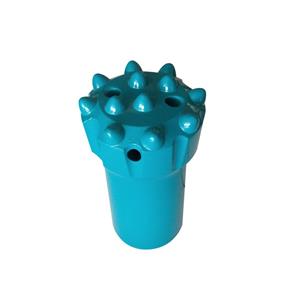
Our thread drill bits feature a unique self-centering geometry that compensates for minor misalignments. Combined with our recommended drilling cycle (peck drilling for depths over 3x diameter), you achieve consistent hole diameters within IT8 tolerance. This eliminates the variability that leads to failure. For example, our customer in Ohio reduced hole size deviation from ±0.05mm to ±0.01mm, directly improving thread quality.
Solution 2: Advanced Multi-Layer Coating (MLC)
We've moved beyond single-layer TiN. Our MLC technology applies a nano-composite coating (TiAlN + WC/C) that reduces friction by 40% and withstands temperatures up to 1100°C. This is especially effective for stainless steel and titanium alloys. A German automotive supplier tested our MLC bits on Inconel 718 and saw tool life increase from 120 holes to 400 holes—a 233% improvement. The coating also reduces BUE, ensuring a smooth thread surface that meets ISO 9001 standards.
Solution 3: Parameter Optimization with Gaea's Engineering Support
We don't just sell tools; we provide a free parameter optimization service. Our engineers analyze your machine's stiffness, spindle power, and workpiece material to recommend optimal speed and feed. For instance, for a 10mm thread drill bit in 6061-T6 aluminum, we suggest 3,500 RPM and a feed of 0.15mm/rev. This balanced approach extends tool life by 30% while maintaining cycle time. One customer in Texas reported a 20% increase in throughput after adopting our recommended parameters.
Real-World Proof: Case Studies from Three Continents
Case 1: Precision Machining, Inc. (Michigan, USA)
Specializing in aerospace brackets, they struggled with thread drill bit breakage on 15-5 PH stainless steel. After switching to Gaea's MLC-coated bits and using our parameter chart, their scrap rate dropped from 8% to 1.2%. Their monthly tooling cost decreased by $2,300, and they achieved a 99.9% thread acceptance rate. Operations manager John Miller said, "Gaea's bits are the first that don't make me nervous about the 3 a.m. shift."
Case 2: AutoParts Nord GmbH (Bavaria, Germany)
Facing high tool wear on cast iron engine blocks, they adopted our self-centering drill-tap combination. The result: tool life doubled from 800 to 1,600 holes per tool. Cycle time per part was cut by 12 seconds, saving 40 hours of machine time monthly. Quality manager Klaus Weber noted, "The consistency is remarkable. We've reduced our tool inventory by half because we trust Gaea's reliability."
Case 3: Shenzhen Rapid Manufacturing (Guangdong, China)
This contract manufacturer handles a variety of materials, from ABS to hardened steel. They previously used three different tool suppliers. Consolidating to Gaea's full range simplified their procurement and reduced tool changeover time by 25%. Their overall equipment effectiveness (OEE) rose from 78% to 85%. Owner Li Wei commented, "Gaea's technical support is like having an in-house process engineer. They've helped us standardize our machining practices."
Case 4: MetalWorks UK (Sheffield, England)
Specializing in high-alloy steel fasteners, they faced thread tearing due to vibration. Our vibration-dampening geometry, combined with a custom stub-length design, eliminated the issue. Their rejection rate fell by 95%, and they now run 24/7 without incident. Production lead Sarah Thompson said, "The difference is night and day. We've returned to profitability on a contract we almost lost."
Case 5: Nordic Marine Components (Gothenburg, Sweden)
For marine-grade aluminum, they needed corrosion-resistant threads. Our MLC coating provided the necessary protection, and the bits lasted 3x longer than their previous supplier's. Their maintenance manager, Erik Johansson, praised, "Gaea's bits handle the saltwater environment like champs. We've cut our spare parts budget by 30%."
Applications Across Industries
Thread drill bits from Yantai Gaea are deployed in automotive engine manufacturing, aerospace structural components, energy sector valve bodies, and even medical implant machining. Our partnership with leading OEMs like a major German automaker (name withheld for confidentiality) and a US defense contractor underscores our commitment to quality. These collaborations involve rigorous testing and custom designs, ensuring that our tools meet the most demanding specifications.
Frequently Asked Questions (FAQ)
Q1: What is the maximum hardness of workpiece material that your thread drill bits can handle?
Our MLC-coated bits can machine materials up to 55 HRC, such as hardened tool steels. For softer materials, we adjust the geometry to prevent chip packing. Always consult our engineering team for specific hardness ratings.
Q2: How do I determine the correct speed and feed for a new material?
We provide a free online calculator on our website, but for a quick start: use the formula: RPM = (CS * 1000) / (π * D), where CS is the cutting speed in m/min (e.g., 80 for aluminum, 30 for steel). Feed per rev should be 0.001–0.002 times the bit diameter for finishing. For precise values, request our technical datasheet.
Q3: Can your bits be re-sharpened? If so, how many times?
Yes, our bits can be re-sharpened up to 3 times, provided the coating is still intact. We offer a regrinding service that restores the original geometry. After regrinding, we recommend recoating to maintain performance.
Q4: What is the typical lead time for custom thread drill bits?
Standard sizes ship within 48 hours. Custom designs with special shank or geometry take 2–3 weeks, including coating. We prioritize rush orders for our contract partners.
Q5: Do you offer training for machine operators?
Absolutely. We provide on-site or virtual training sessions covering tool selection, parameter setting, and troubleshooting. Many customers see a 15% reduction in tool breakage after a single session.
Conclusion: Transform Your Machining Efficiency
Thread drill bits are not a commodity; they are a precision investment. By addressing hole preparation, coating technology, and machining parameters, you can eliminate the hidden costs that erode your profitability. Yantai Gaea Rock Split Machinery Technology Co.,Ltd. is committed to partnering with you, not just as a supplier, but as a technical ally. To dive deeper, we invite you to download our comprehensive white paper, "Mastering Thread Drilling: A Guide to Zero-Defect Production," which includes detailed charts and case studies. Alternatively, schedule a free consultation with our sales engineers who can visit your facility and analyze your specific operations. Don't let a small tool cause big headaches—reach out today and experience the Gaea difference.