Saudi Arabia's Construction Pipeline in 2026: NEOM, FIFA 2034, and the Rock Excavation Challenge
Saudi Arabia Is Building the Largest Construction Program on Earth
In 2026, Saudi Arabia's construction sector is operating at a scale that has no parallel in modern history. The kingdom's Vision 2030 transformation program — now expanded and reallocated toward new priorities — continues to generate one of the most concentrated bursts of infrastructure investment the world has ever seen.
Three major program streams are driving demand simultaneously:
NEOM: Where the Shovels Are Actually in the Ground
NEOM remains Saudi Arabia's most visible megaproject, even after the significant recalibration announced in early 2026. The headline adjustments are well documented — The Line scaled from 170 km to an initial 2 km phase, PIF construction contracts reduced from USD 71 billion to USD 30 billion. But the recalibration tells only part of the story.
What matters for contractors and equipment suppliers is what is happening on the ground right now:
260 excavators and 2,000 trucks are operating around the clock at The Line's 2 km initial phase near Sharma, clearing terrain and laying foundations for a proof-of-concept segment designed to house approximately 300,000 residents
The NEOM Green Hydrogen Plant is 80% complete at USD 8.4 billion, making it the most advanced piece of infrastructure in the entire NEOM ecosystem
Sindalah Island — a USD 4 billion luxury marina and resort — is on track for a soft opening in late 2026
Magna involves hollowing out entire mountains to create an integrated luxury resort, requiring large-scale underground excavation techniques normally seen in tunneling and mining
The Tabuk Province desert geology presents formidable challenges. Engineers are dealing with soil stability, deep rock formations, and seismic resilience requirements for structures reaching 500 meters. Real-time geotechnical monitoring systems track ground movement during excavation.
FIFA 2034: The New Construction Priority
With FIFA 2034 now the highest-priority construction program in the kingdom, the procurement pipeline is accelerating sharply:
15 stadiums across 5 host cities — a combination of 4 existing renovations, 3 under construction, and 8 planned new builds
16 new or significantly upgraded stadium facilities required across Riyadh, Jeddah, and Al Khobar
Supporting infrastructure includes metro extensions, airport capacity upgrades, and hospitality developments
The FIFA delivery timeline is fixed: 2030 represents the midpoint deadline for infrastructure completion, meaning the 2026-2028 window is the peak construction period for stadium foundations, access roads, and utility connections.
Expo 2030 Riyadh
The 600-hectare Expo site requires core pavilion infrastructure, utility connections, and access roads on a fixed delivery deadline. Site preparation, foundation work, and rock excavation are already underway to meet the timeline.
The Rock Excavation Bottleneck
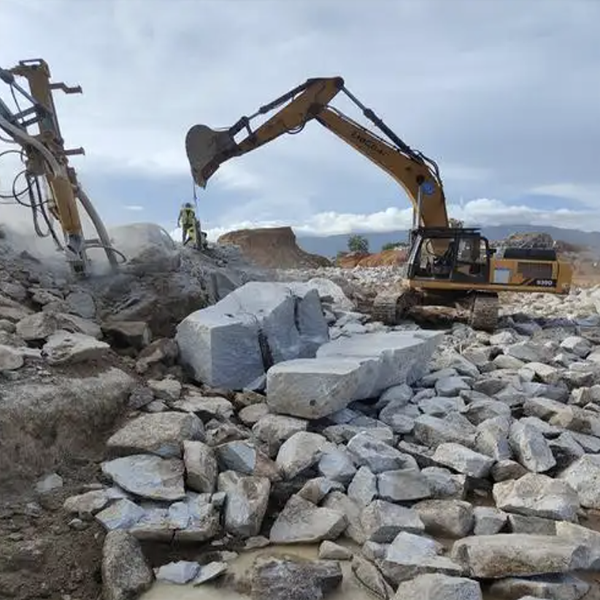
Every one of these projects — from NEOM's mountain resort at Magna to FIFA stadiums in Riyadh to the Expo site — shares a common requirement: moving a lot of rock, fast, and within environmental and safety constraints.
Saudi Arabia's construction sector faces four interconnected challenges that make conventional explosive blasting increasingly problematic:
1. Regulatory Complexity
Saudi Arabia's explosive regulations require multiple permits for procurement, transport, storage, and on-site use of industrial explosives. For international contractors already navigating the complexities of Saudi licensing systems, the added layer of explosive permitting creates significant timeline risk. Secure storage facilities must meet stringent military-grade standards, and armed transport is mandatory.
2. Proximity Constraints in Urban Zones
Most FIFA stadium sites in Riyadh and Jeddah are in or near urban areas. Conventional explosives require exclusion zones of 200-500 meters, meaning every blast operation forces a halt to all nearby construction activity. In dense urban environments, this is a critical productivity killer.
3. Environmental Standards Are Rising
NEOM is explicitly committed to reducing carbon in construction. Saudi Arabia's broader environmental standards are tightening under Vision 2030 sustainability targets. Conventional explosives produce nitrogen oxides, carbon monoxide, and fine particulate matter — emissions that are increasingly scrutinized in environmental impact assessments.
4. Scale Demands Speed
The construction program's sheer scale demands rapid, repeatable rock-breaking cycles. Any delay in material supply, permitting, or regulatory compliance directly cascades into project timelines measured in billions of dollars.
A Multi-Tool Approach to Saudi Arabia's Rock Excavation Needs
No single rock-breaking technology is the right answer for every situation. Forward-thinking contractors working on Saudi Arabia's megaproject pipeline are deploying a combination of complementary solutions that address different site conditions and project phases.
O2 Gas Energy Rock Splitting System — For Large-Scale Rock Fragmentation
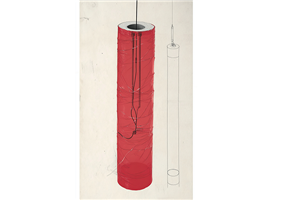
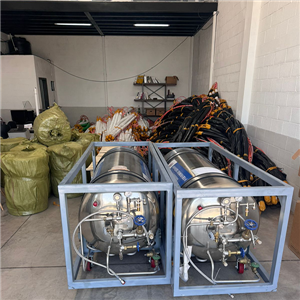
The O2 Gas Energy Rock Splitting System (Liquid Oxygen Rock Blasting System) is the primary solution for large-scale rock fragmentation in quarrying, mining, and heavy civil excavation.
How it works: Specialized paper splitting tubes are placed in pre-drilled boreholes, and liquid oxygen is injected from a refillable gas filling tank. When remotely triggered, the liquid oxygen vaporizes and expands approximately 860 times its volume, generating controlled pressure that fractures rock along designed planes. The byproducts are only water vapor and carbon dioxide.
Why it fits Saudi Arabia:
No explosive permits required — liquid oxygen and paper splitting tubes are classified as ordinary cargo, eliminating weeks of regulatory delay
2-3 meter safety zone versus 200-500 meters for conventional explosives, enabling concurrent construction operations
Approximately USD 1 per cubic meter — 20-65% cheaper than conventional explosives
Works in water-saturated boreholes — critical for coastal sites along the Red Sea and Gulf coastlines
70% less shockwave than conventional explosives, protecting adjacent structures in urban zones
40HQ container holds material for 131,250 cubic meters of rock fragmentation
For NEOM's mountain excavation at Magna, FIFA stadium foundation work, and Expo site preparation, the O2 system offers the throughput and scale needed for sustained large-volume rock breaking.
Hydraulic Rock Splitter — For Precision and Urban Proximity
When rock excavation must happen within meters of existing structures — as is the case with stadium renovations in Riyadh and Jeddah, or infrastructure upgrades near active urban corridors — the hydraulic rock splitter provides surgical precision.
How it works: The hydraulic splitter uses the wedge principle, releasing enormous splitting force outward from a narrow borehole. Electric-powered and diesel-powered variants are available to match site conditions.
Why it fits Saudi Arabia:
Zero exclusion zone — operates safely directly adjacent to structures
Silent operation — no noise, no vibration, making it suitable for nighttime work in residential areas
5-12 second splitting cycle for granite, basalt, and limestone
Electric and diesel variants available for different site power availability
Continuous, controllable power with safety interlocks
For renovation projects at the 4 existing FIFA stadiums, utility trenching in Riyadh's urban core, and precision excavation around NEOM's Green Hydrogen Plant infrastructure, the hydraulic rock splitter is the right tool.
Expansion Mortar (Expanding Grout) — For Sensitive Environments
For the most sensitive applications — demolition near heritage sites, rock breaking in environmentally protected zones, or situations where any vibration whatsoever is unacceptable — expansion mortar (expanding grout) offers the gentlest possible approach.
How it works: A non-explosive, eco-friendly slurry is poured into drilled holes and expands overnight to fracture rock without noise, vibration, or flyrock.
Why it fits Saudi Arabia:
Completely silent — no noise, no vibration, no flyrock at all
Eco-friendly — non-toxic, no emissions
Overnight action — pour in the evening, rock is fractured by morning
Effective on marble, granite, limestone, concrete, and boulders
No permits, no special transport, no storage restrictions
For heritage-sensitive areas near Diriyah, environmentally protected zones along the Red Sea coast, and situations where dust and noise are absolutely prohibited, expansion mortar provides a solution that no explosive can match.
Putting the Right Tool on the Right Job
The key insight for contractors working in Saudi Arabia is that these three technologies are not competitors — they are complementary tools for different stages and conditions of rock excavation projects:
A contractor equipped with all three can handle the full spectrum of rock excavation challenges that Saudi Arabia's construction pipeline throws at them — without ever needing to touch conventional explosives.
Saudi Arabia's Window of Opportunity
The 2026-2030 period represents the peak of Saudi Arabia's construction activity. NEOM's active phases, FIFA 2034 stadium construction, Expo 2030 site preparation, and the broader Vision 2030 infrastructure program are generating demand for rock excavation services that will not be repeated at this intensity.
Contractors who can mobilize quickly, comply with Saudi Arabia's evolving environmental standards, and operate without the regulatory burden of explosive permitting will have a significant competitive advantage in this market.
The tools to seize that advantage are available now.